
 en
en English
 中文简体
中文简体 русский
 Español
 عربى
عربى
Why SPE is the Future of Smart Manufacturing
Content
In the evolution of the Industrial Internet of Things (IIoT) and smart manufacturing, enterprises have constantly faced a major pain point: top-level networks (like control rooms and servers) use high-speed Ethernet, while bottom-level sensors and actuators are often restricted to outdated, low-speed, and incompatible fieldbuses due to space and wiring cost limitations.
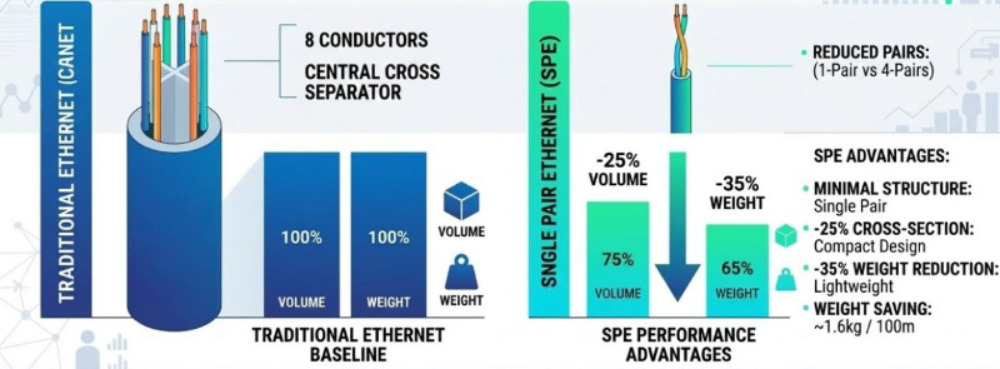
The emergence of Single Pair Ethernet (SPE) has completely broken this deadlock. It simplifies the traditional 4-pair (8-core) Ethernet cable down to just 1 pair (2 cores), yet still achieves high-speed data transmission and synchronized power supply. This is not just a physical "slimming down," but a fundamental revolution that enables seamless, all-IP communication from the sensor directly to the cloud.
Core Comparison: SPE vs. Traditional Ethernet
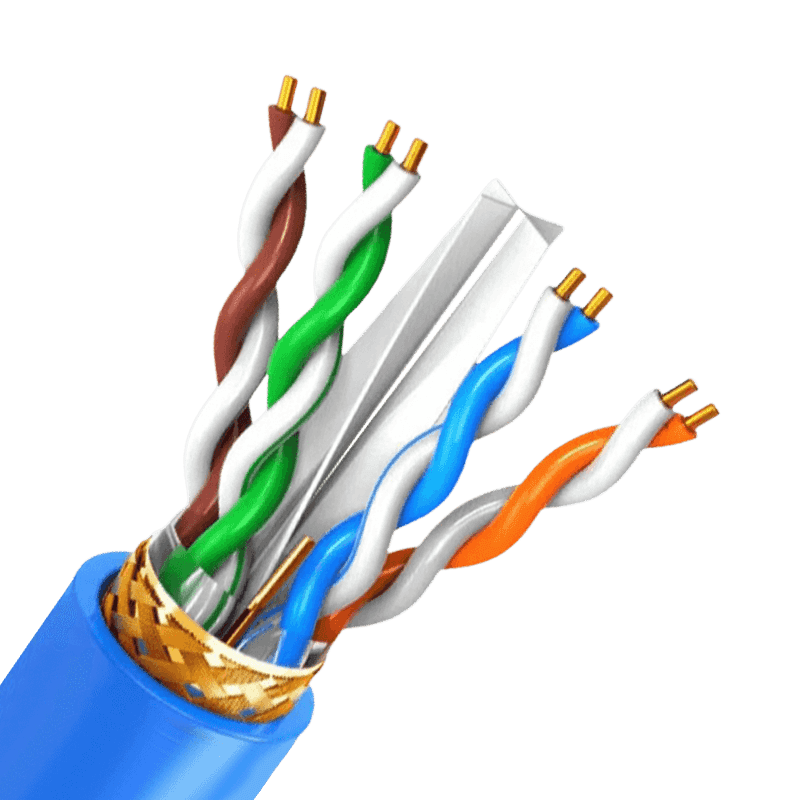
The Cat5e or Cat6 cables we are most familiar with contain 8 copper wires, and traditional Ethernet wiring is typically strictly limited to a maximum distance of 100 meters. This design is perfect for office environments, but it appears bulky and restricted in extremely compact and harsh industrial settings (such as inside multi-axis robotic arms or along thousands of meters of pipelines).
The disruptive advantages of SPE include:
- Minimalist Structure: Completely abandons the cross-web filler and the extra 6 wires, requiring only a single balanced twisted pair.
- Drastic Reduction in Volume & Weight: Compared to traditional industrial Ethernet wiring, SPE reduces the installation cross-sectional area by about 25% and the overall weight by 35%. In large data racks or railway transit systems, this eliminates approximately 1.6 kg of dead weight per 100 meters.
- Superior Flexibility & Torsion Resistance: The single-pair symmetrical structure physically avoids the problem of internal "wire friction." Combined with special filler materials, SPE can withstand tens of millions of high-frequency bending cycles and severe 3D torsion, making it a perfect match for industrial robots.
Three Core Industry Pain Points Solved by SPE
1. Breaking the 100-Meter Physical Distance Limit
In process automation scenarios like oil and chemical industries, equipment is widely distributed, making the traditional 100-meter limit a fatal flaw. The 10BASE-T1L standard within the SPE protocol family enables 10Mbps high-speed full-duplex transmission over distances up to 1000 meters, completely curing the "distance anxiety" of industrial wiring.
2. PoDL: Killing Two Birds with One Stone (Data & Power)
Traditional devices often require separate cables for data and power. SPE introduces Power over Data Lines (PoDL) technology, allowing the simultaneous transmission of data and up to approximately 50W of DC power to terminal devices. For heavy-duty equipment, the industry has introduced Hybrid interface topologies, isolating high-speed data and up to several kilowatts of power supply within the same link, greatly simplifying equipment routing.
3. Eliminating Gateways for "Network Flattening"
In the past, factories had to deploy numerous expensive "protocol conversion gateways" to allow bottom-level analog signals to communicate with the top level. SPE allows even the tiniest bottom-level sensors to have independent IP addresses and connect directly to the TCP/IP network. It is estimated that eliminating a single gateway node can save over $10,000 in comprehensive costs over the system's lifecycle.
Core Protocols and Interface Ecosystem
Applying SPE doesn't require diving into complex underlying codes; you simply need to recognize the following core standards that determine its performance:
1. Transmission Speed & Distance Matrix (IEEE 802.3 Series)
- 10BASE-T1L: 10 Mbps speed, up to 1000 meters. Designed for long-distance process control, supporting intrinsic safety in explosive environments (Ethernet-APL).
- 10BASE-T1S: 10 Mbps speed, supporting Multidrop topology. Allows over a dozen devices to be connected in parallel on a single main line up to 25 meters long, eliminating massive star-topology wiring.
- 100/1000BASE-T1: 100 Mbps or 1 Gbps Gigabit speed, up to 15-40 meters. Primarily used for high-speed interconnection inside vehicles or high-resolution industrial machine vision.
2. Industrial Connection Interface Standards (IEC 63171 Series)
Because traditional RJ45 connectors are too bulky and lack vibration resistance, the industry has established new standards:
- IEC 63171-6 and other micro-interfaces: Covering IP20 to IP67 protection ratings, these are shock and drop resistant. Their volume is only a fraction of traditional interfaces, making them the main connectors for next-generation devices.
- M12 Hybrid Interface (IEC 63171-7): The ultimate solution for high-power devices. The standard defines combinations of data pins and multiple high-power supply pins, supporting the simultaneous transmission of "data + power" for heavy equipment like motors and servo drives.

Frequently Asked Questions (FAQs)
Q1: Is SPE slower than traditional networks?
No. Network speed depends on the protocol standard, not the physical thickness of the link. SPE can also support Gigabit speeds up to 1 Gbps over short distances (e.g., 40 meters).
Q2: Is SPE's Power over Data Lines (PoDL) the same as PoE?
The purpose is the same, but the underlying technology is different. Traditional PoE relies on spare pairs or phantom power within 4-pair cables, whereas PoDL can mix and transmit high-frequency data and DC power simultaneously on a single pair (2-core) physical circuit.
Q3: Can ordinary 2-core wires or stripped old Ethernet cables be used directly as SPE cables?
Highly not recommended. A true SPE transmission system undergoes strict optimization for impedance, return loss, and crosstalk specifically for single-pair high-frequency transmission. Industrial SPE cables also include special flexible structural elements that ordinary copper wires simply cannot match.
Conclusion
Single Pair Ethernet (SPE) is by no means a technical downgrade of "having fewer copper wires"; it is the physical-layer cornerstone for industrial automation moving towards true digitalization and intelligence. For enterprises that incorporate SPE technology into their infrastructure planning early on, it not only drastically cuts current deployment and maintenance costs but also seizes the high ground in the next-generation Internet of Everything architecture.
As a manufacturer focused on high-quality cables, the HUAPUCABLE team always keeps pace with cutting-edge industrial communication technologies, dedicated to providing global customers with reliable cable solutions that meet rigorous industrial standards. Feel free to contact our team to get the cable specifications and quotes tailored to your projects.

- +86-13588204183
- No. 39 Zhiyuan Road, Deqing Economic Development Zone, Huzhou City, Zhejiang Province

Copyright © Zhejiang Huapu Cable Co., Ltd. All Rights Reserved.
 ISO 9001 Cable Manufacturer