
 en
en English
 中文简体
中文简体 русский
 Español
 عربى
عربى
Is Cat6a or Cat8 Better for Home Network in 2026?
Content
- 1.Introduction: Core Question and Objective Positioning
- 2.Technical Specifications Comparison (Based on Standards and Real-World Data)
- 3.Typical Home Networking Requirements in 2026
- 4.Balanced Pros and Cons Comparison
- 5.Industry Consensus and Community Feedback (2025–2026)
- 6.Home Networking Recommendation Summary
- 7.Installation Recommendations
The following article, structured with numbered sections for clear hierarchy, provides an objective comparison based on 2025–2026 standards, real-world performance, and industry consensus.
1.Introduction: Core Question and Objective Positioning
In 2025–2026, for the vast majority of home networks, “Cat6a is the more appropriate and balanced choice”. While Cat8 offers higher theoretical bandwidth, its advantages are mostly limited to data-center short-distance scenarios and rarely justify the added cost and complexity in residential settings.
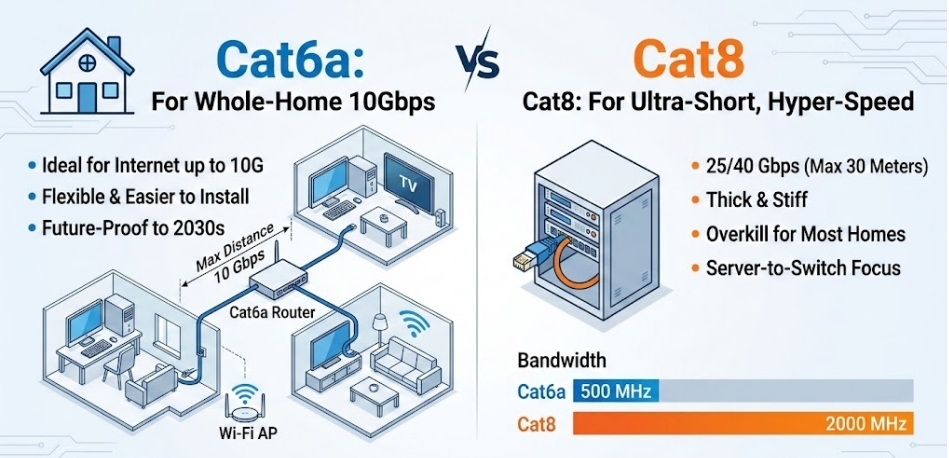
Figure 1: Comparison of Cat6a vs Cat8 whole-house cabling and short-range interconnection
2.Technical Specifications Comparison (Based on Standards and Real-World Data)
2.1 Core Parameters Table
|
Feature |
Cat6a |
Cat8 (Cat8.1 / Cat8.2) |
|
Maximum Rated Speed |
10 Gbps |
25 Gbps or 40 Gbps |
|
Bandwidth (Frequency) |
500 MHz |
2000 MHz |
|
Full-Speed Maximum Distance |
100 meters |
30 meters |
|
Shielding |
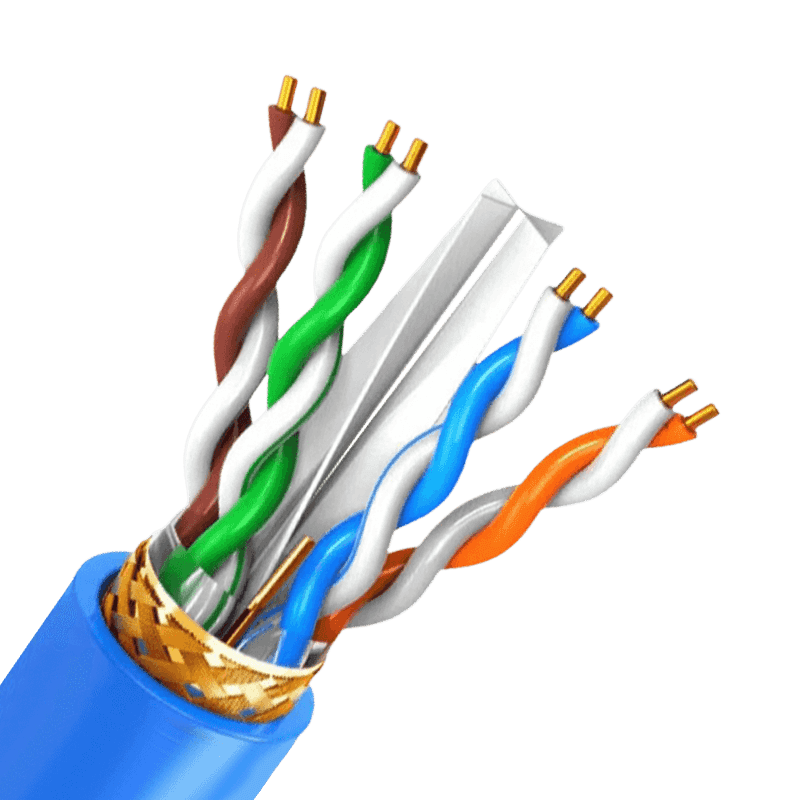
Often F/UTP or S/FTP (recommended for reliable 10G) |
Mandatory S/FTP (heavy shielding) |
|
Cable Thickness & Flexibility |
≈6–7 mm, more flexible |
≈8–9 mm+, much stiffer and bulkier |
|
Typical Cost (quality solid copper, per 100 m) |
$60–150 |
$250–600+ (usually 3–5× higher) |
|
Primary Designed Use |
Enterprise LANs, offices, modern homes |
Data center short interconnects (server-to-switch) |
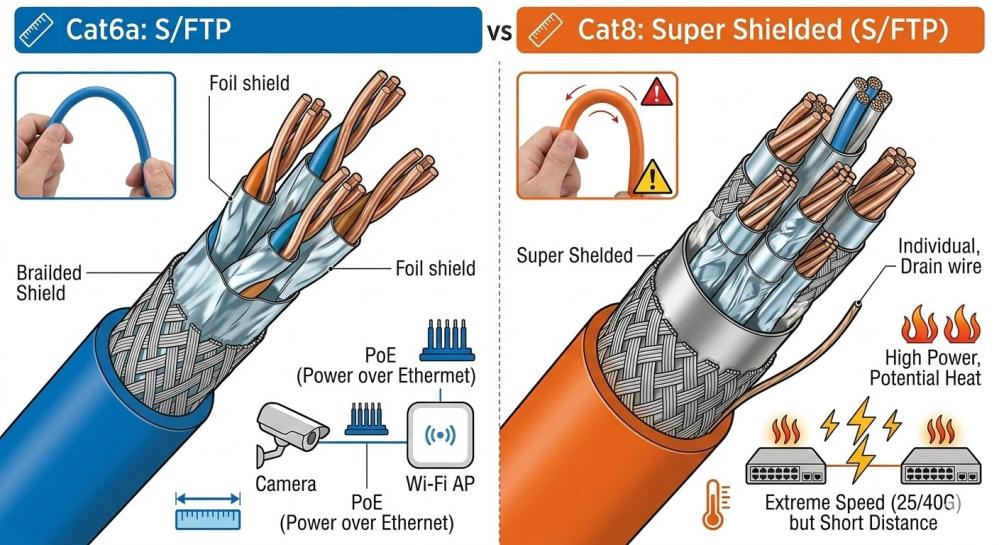
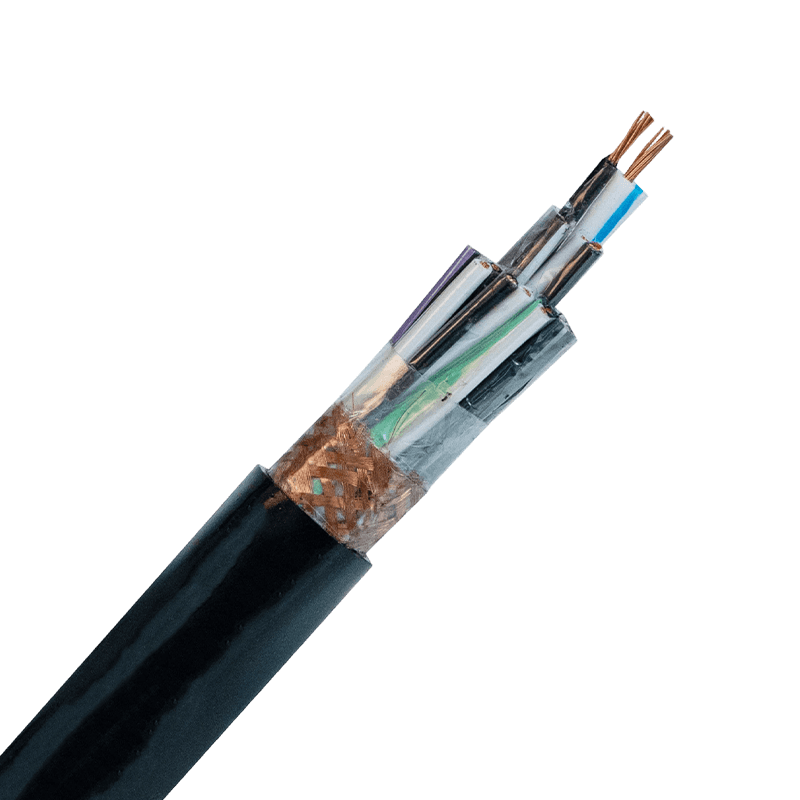
Figure 2: Comparison of cross-sectional structure and physical properties of Cat6a and Cat8 cables
2.2 Specification Notes
These values are based on TIA/EIA standards and consistent manufacturer data. No major changes have occurred since Cat8 was standardized around 2016–2017 that would improve its suitability for typical home use.
3.Typical Home Networking Requirements in 2026
3.1 Common Usage Scenarios
- Internet access: 500 Mbps – 10 Gbps (fiber or advanced cable broadband in many markets)
- Local traffic: 4K/8K streaming, NAS file transfers, gaming, multiple Wi-Fi 6E/7 access points, smart devices, security cameras
- Cable run lengths: Most home drops range from 15–70 meters (many exceed 30 m due to room layouts)
- End devices: Consumer PCs, consoles, TVs, and NAS units generally max out at 1/2.5/10 Gbps ports; 25/40 Gbps NICs remain rare and expensive
3.2 Distance and Practical Performance Limits
Cat6a reliably delivers 10 Gbps over 100 meters, covering full-home wiring with margin for interference and future upgrades.
Cat8’s 25–40 Gbps capability is restricted to 30 meters; beyond that, performance falls back to levels similar to or no better than Cat6a—while the cost increases significantly.
4.Balanced Pros and Cons Comparison
4.1 Cat6a Advantages for Home Use
- Reliable 10 Gbps across realistic home distances
- Backward compatible with all previous categories
- Reasonable cost and wide availability
- Excellent PoE support (cameras, wireless APs, etc.)
- Sufficient headroom for multi-gig internet and local traffic well into the early 2030s
4.2 Cat6a Limitations
- Capped at 10 Gbps (still far exceeds the needs of nearly all current home devices)
4.3 Cat8 Advantages
- Highest copper bandwidth and strong noise rejection
- Useful for extremely short, high-density connections
4.4 Cat8 Major Drawbacks in Home Contexts
- Strict 30-meter limit for full 25/40 Gbps performance
- Significantly higher cost with little to no proportional benefit
- Much harder to install (stiffer, thicker—more difficult to pull through walls and tight bends)
- No speed advantage when connected to typical 10 Gbps (or slower) ports and switches
5.Industry Consensus and Community Feedback (2025–2026)
Discussions on Reddit (r/HomeNetworking, r/homelab), manufacturer guides, and technical articles from 2025–2026 consistently describe Cat8 as overkill or data-center-specific for residential applications. Even in prosumer setups with NAS and 10G devices, the prevailing recommendation is Cat6a for its practical balance of capability, cost, and ease of installation.
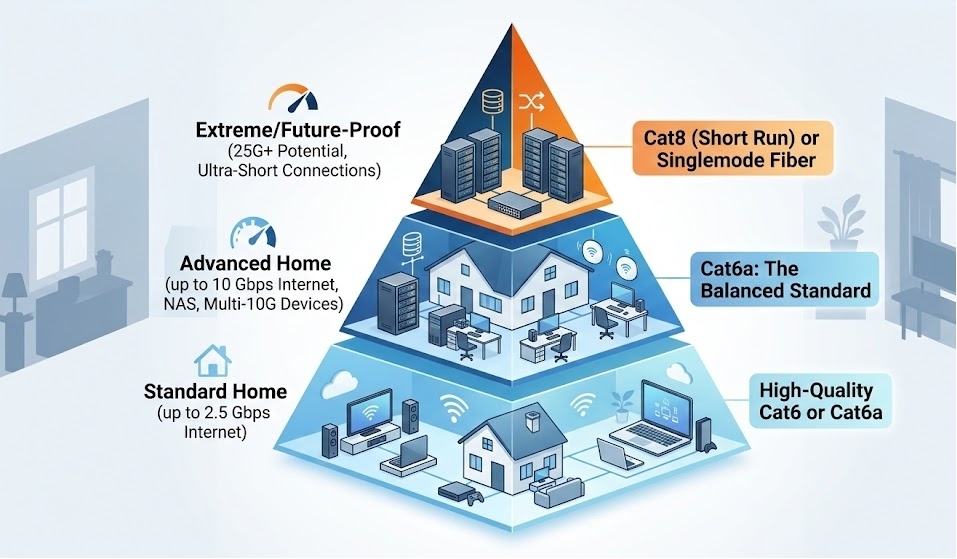
Figure 3: 2025/2026 Home Network Cabling Tier Recommendation Pyramid
6.Home Networking Recommendation Summary
6.1 Standard Homes (streaming, gaming, smart devices, up to 5–10 Gbps internet)
→ High-quality Cat6 is often sufficient; "Cat6a provides better future-proofing and interference resistanc".
6.2 Advanced / Larger Homes (10 Gbps internet, heavy NAS usage, multiple 10G devices, new construction or full re-wire)
→ "Cat6a is the recommended standard".
6.3 Consider Cat8 only in these rare cases:
- Very short runs (<30 m) to a small number of 25/40 Gbps devices
- Home data-center-like layout
- Budget is not a concern and matching high-speed hardware is already in use
7.Installation Recommendations
For most residential projects—even tech-heavy ones—Cat6a offers the best combination of performance, reliability, installation ease, and value.
Use solid pure-copper cable (avoid CCA/clad aluminum), follow T568-B termination standard, and test all runs to ensure long-term stability through the 2030s and beyond.

- +86-13588204183
- No. 39 Zhiyuan Road, Deqing Economic Development Zone, Huzhou City, Zhejiang Province

Copyright © Zhejiang Huapu Cable Co., Ltd. All Rights Reserved.
 ISO 9001 Cable Manufacturer