
 en
en English
 中文简体
中文简体 русский
 Español
 عربى
عربى
What Is Class 5 Conductor Flexibility? IEC 60228 Standards Explained
Content
- Understanding the IEC 60228 Conductor Classification Framework
- What Makes a Conductor "Class 5"? Technical Specifications
- Class 5 vs. Class 2 Conductors: Core Differences
- Key Applications of IEC 60228 Class 5 Conductors
- Why Specifying IEC 60228 Class 5 Matters for Your Project
- Frequently Asked Questions About Class 5 Conductors
Key takeaway: Class 5 conductors, defined by IEC 60228, are fine-stranded flexible conductors used in extension leads, control panels, and industrial applications. This guide covers the technical specifications, comparison with Class 2, and how to select the right conductor for your project.
In the world of electrical engineering and cable manufacturing, "flexibility" is not just a physical trait — it is a strictly defined technical category. If you have ever handled a stiff power cable versus a supple, easy-to-bend control wire, you have experienced the difference between conductor classes firsthand.
Most of these specifications are governed by the international standard IEC 60228. This guide takes a deep dive into Class 5 conductors — the industry standard for flexible applications — covering construction requirements, electrical limits, and real-world use cases.
Understanding the IEC 60228 Conductor Classification Framework
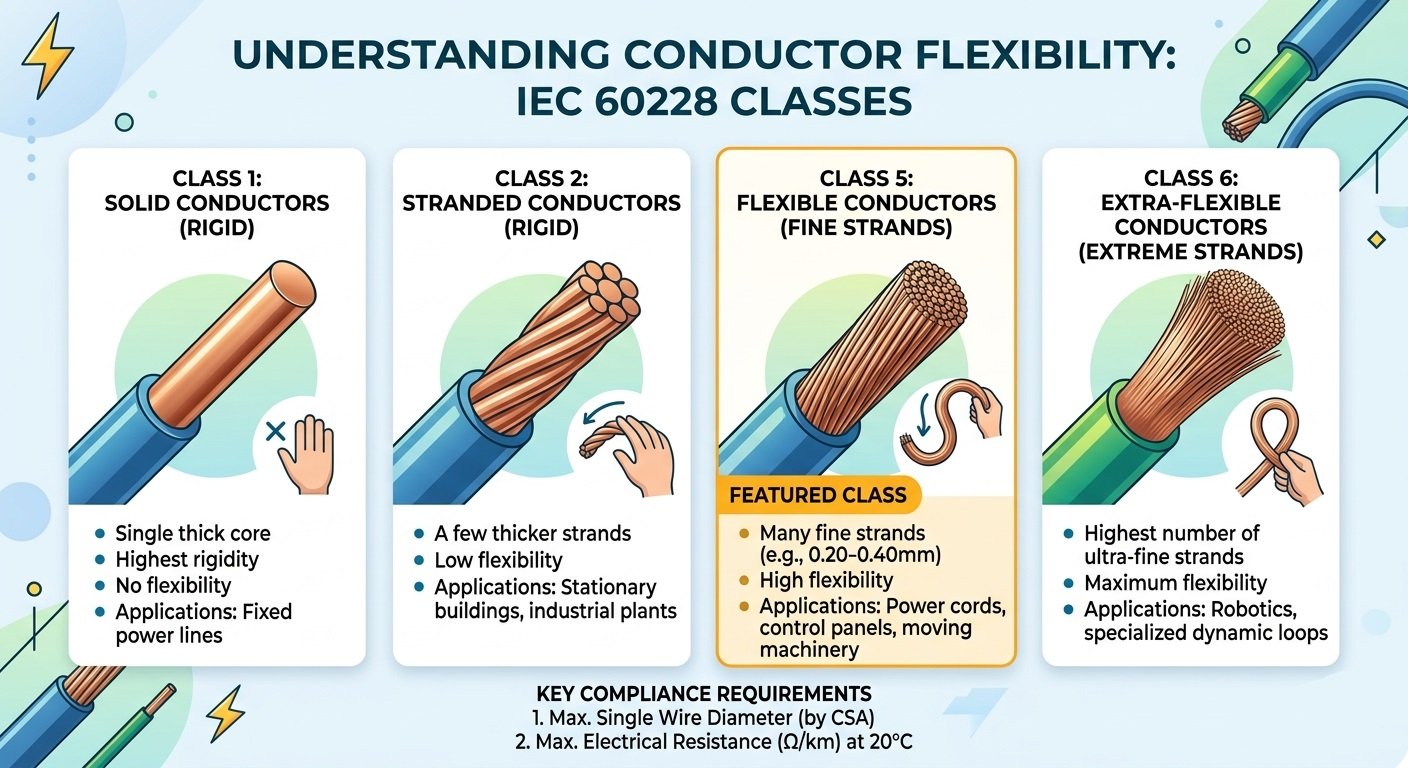
IEC 60228 (and its British equivalent BS EN 60228) classifies conductors into four main classes based on construction and flexibility. Understanding where Class 5 sits in this hierarchy is essential for correct product selection:
|
Class |
Type |
Description |
|
Class 1 |
Solid (Rigid) |
Single solid wire; used for fixed, permanent installations where no movement occurs. |
|
Class 2 |
Stranded (Rigid) |
Multiple thicker wires; standard for house wiring and power grids in fixed installations. |
|
Class 5 |
Flexible (Fine strands) |
Many fine copper wires stranded together; designed for frequent bending and movement. |
|
Class 6 |
Extra-Flexible (Finest strands) |
Even finer strands than Class 5; used in highly dynamic applications requiring maximum flexibility. |
What Makes a Conductor "Class 5"? Technical Specifications
A Class 5 conductor consists of multiple fine copper wires stranded together to achieve flexibility. Contrary to common assumptions, IEC 60228 does not strictly prescribe the total number of strands. Instead, the standard mandates compliance with two primary metrics:
1. Maximum Diameter of Individual Wires
To ensure the conductor remains genuinely flexible, IEC 60228 sets a strict upper limit on the diameter of each individual strand. Thinner strands bend more easily, reducing metal fatigue over repeated flexing cycles. Representative examples from the standard include:
- 75 mm² conductor → maximum individual wire diameter: 0.21 mm
- 5 mm² conductor → maximum individual wire diameter: 0.26 mm
- 10 mm² conductor → maximum individual wire diameter: 0.41 mm
- 35 mm² conductor → maximum individual wire diameter: 0.41 mm
2. Maximum Electrical Resistance at 20°C
Electrical resistance is the defining performance criterion. The total resistance of the completed Class 5 conductor must not exceed the values specified in the IEC 60228 resistance tables, measured at 20°C. This rule allows manufacturers design flexibility: if a manufacturer uses 0.20 mm wires instead of the 0.21 mm maximum, that is acceptable — provided the finished conductor still meets the resistance limit.
This two-parameter approach (wire diameter + resistance) ensures Class 5 conductors are both physically flexible and electrically efficient, without over-specifying the manufacturing process.
Class 5 vs. Class 2 Conductors: Core Differences
Electrical engineers frequently face the choice between Class 2 and Class 5 conductors. The decision depends on whether the cable will be in a fixed installation or a mobile/flexible application. Here is a direct comparison:
|
Feature |
Class 2 (Stranded, Fixed) |
Class 5 (Flexible) |
|
Construction |
Fewer, thicker wires |
Many fine wires |
|
Flexibility |
Low — suited for fixed wiring |
High — suited for movement |
|
Typical Applications |
House wiring, power grids |
Extension leads, control panels |
|
Termination Method |
Simple lugs or screws |
Ferrules recommended |
|
Metal Fatigue Resistance |
Low (not designed for flexing) |
High (designed for repeated bending) |
|
Cost |
Generally lower |
Slightly higher due to fine stranding process |
Key Applications of IEC 60228 Class 5 Conductors
Because Class 5 conductors can withstand moderate vibration and repeated bending without fracturing, they are specified across a wide range of industries:
- Flexible Cords & Extension Leads: Household appliances, power tools, and portable equipment where cables must be coiled, uncoiled, and repositioned regularly.
- Industrial Control Panels: Tight routing around corners and through cable ducts requires the bend radius achievable only with fine-stranded conductors.
- Automotive Wiring Harnesses: Continuous engine vibration and temperature cycling demand conductors that resist metal fatigue over the vehicle's service life.
- Marine & Offshore Installations: Constant movement from waves, combined with confined spaces, makes Class 5 the preferred choice for onboard power distribution.
- Robotics & Automation: Articulated robot arms require cables that flex thousands of times per day without failure — Class 5 meets this challenge for moderate-flex applications (Class 6 for high-flex).
Why Specifying IEC 60228 Class 5 Matters for Your Project
Selecting a cable marketed as "flexible" without referencing a recognized standard such as IEC 60228 Class 5 introduces significant risk. Compliance with this standard provides three concrete guarantees:
- Safety: Resistance limits ensure the conductor does not overheat under rated current, preventing insulation degradation and potential fire hazards.
- Compatibility: Standardized maximum wire diameters ensure the conductor fits correctly into standard lugs, ferrules, and terminal blocks without requiring modifications.
- Longevity: Fine stranding prevents metal fatigue during repeated flexing, significantly extending cable service life compared to non-compliant alternatives.
When sourcing cables internationally, IEC 60228 certification also simplifies regulatory approval, as the standard is adopted or recognized in the EU (BS EN 60228), Australia (AS/NZS 1125), and many other markets.
Frequently Asked Questions About Class 5 Conductors
Is Class 5 the same as flexible cable?
Not exactly. "Flexible cable" is a broad commercial term. Class 5 is a specific IEC 60228 conductor classification with measurable technical requirements. A cable can be marketed as flexible without meeting Class 5 specifications.
Can Class 5 conductors be used outdoors?
Class 5 refers to the conductor construction only, not the overall cable rating. Whether a cable is suitable for outdoor use depends on the insulation and jacket materials (e.g., UV-resistant PVC, XLPE). Always check the complete cable specification, not just the conductor class.
What is the difference between Class 5 and Class 6?
Both are flexible conductor classes. Class 6 uses even finer strands, resulting in greater flexibility and a tighter minimum bend radius. Class 6 is specified for highly dynamic applications such as continuous flexing in drag chains, while Class 5 covers moderate-flex scenarios.
Need Help Selecting the Right Conductor for Your Application?
Our engineering team specializes in IEC 60228-compliant conductors and cables for industrial, marine, automotive, and commercial applications. Whether your project involves high-vibration environments or standard fixed installations, we provide detailed technical specifications and competitive quotes.
Contact us today to discuss your project requirements.

- +86-13588204183
- No. 39 Zhiyuan Road, Deqing Economic Development Zone, Huzhou City, Zhejiang Province

Copyright © Zhejiang Huapu Cable Co., Ltd. All Rights Reserved.
 ISO 9001 Cable Manufacturer