
 en
en English
 中文简体
中文简体 русский
 Español
 عربى
عربى
XLPO vs. XLPE for Solar Cables: Material Differences, Cross-Linking Methods, and Performance Comparison
Content
- What "Cross-Linked" Actually Means
- XLPE: Cross-Linked Polyethylene
- XLPO: Cross-Linked Polyolefin
- XLPO (Cross-Linked Polyolefin) is a broader material family rather than a single polymer. Polyethylene itself belongs to the polyolefin family, meaning XLPE can technically be considered one type of XLPO. However, in the wire and cable industry, the term "XLPO" is commonly used to describe specially formulated cross-linked polyolefin compounds designed for applications requiring enhanced flexibility, UV resistance, and thermal stability—particularly photovoltaic (PV) cables.
- These compounds are typically based on engineered polyolefin blends or polyolefin elastomers combined with UV stabilizers, antioxidants, flame retardants, and other performance-enhancing additives. Most solar-grade XLPO compounds are cross-linked using electron-beam irradiation.
- Mechanical and electrical behavior
- XLPO vs XLPE: Side-by-Side Comparison
- Why It Matters for Solar Installations Specifically
- When XLPE Still Makes Sense
- Frequently Asked Questions
- Key Takeaways
Focus keyword: XLPO vs XLPE solar cable insulation
Meta description: XLPO vs XLPE solar cable insulation compared: polymer chemistry, cross-linking, temperature rating, UV resistance, flexibility, and how to choose the right PV cable material.
Reading time: ~8 minutes
Solar cable insulation has one job that never lets up: keep working for 25 years or more while sitting outdoors in full sun, through freeze-thaw cycles, humidity, and constant electrical load. The polymer that surrounds the copper conductor is what determines whether that promise holds. In photovoltaic (PV) wiring, the two materials that dominate the market are XLPE (cross-linked polyethylene) and XLPO (cross-linked polyolefin). They sound similar, they're often confused, and marketing copy doesn't always make the distinction clear. This article breaks down the underlying material science — what cross-linking actually does, how the two polymer families differ at a chemical level, and which one makes sense for a given solar installation.
What "Cross-Linked" Actually Means
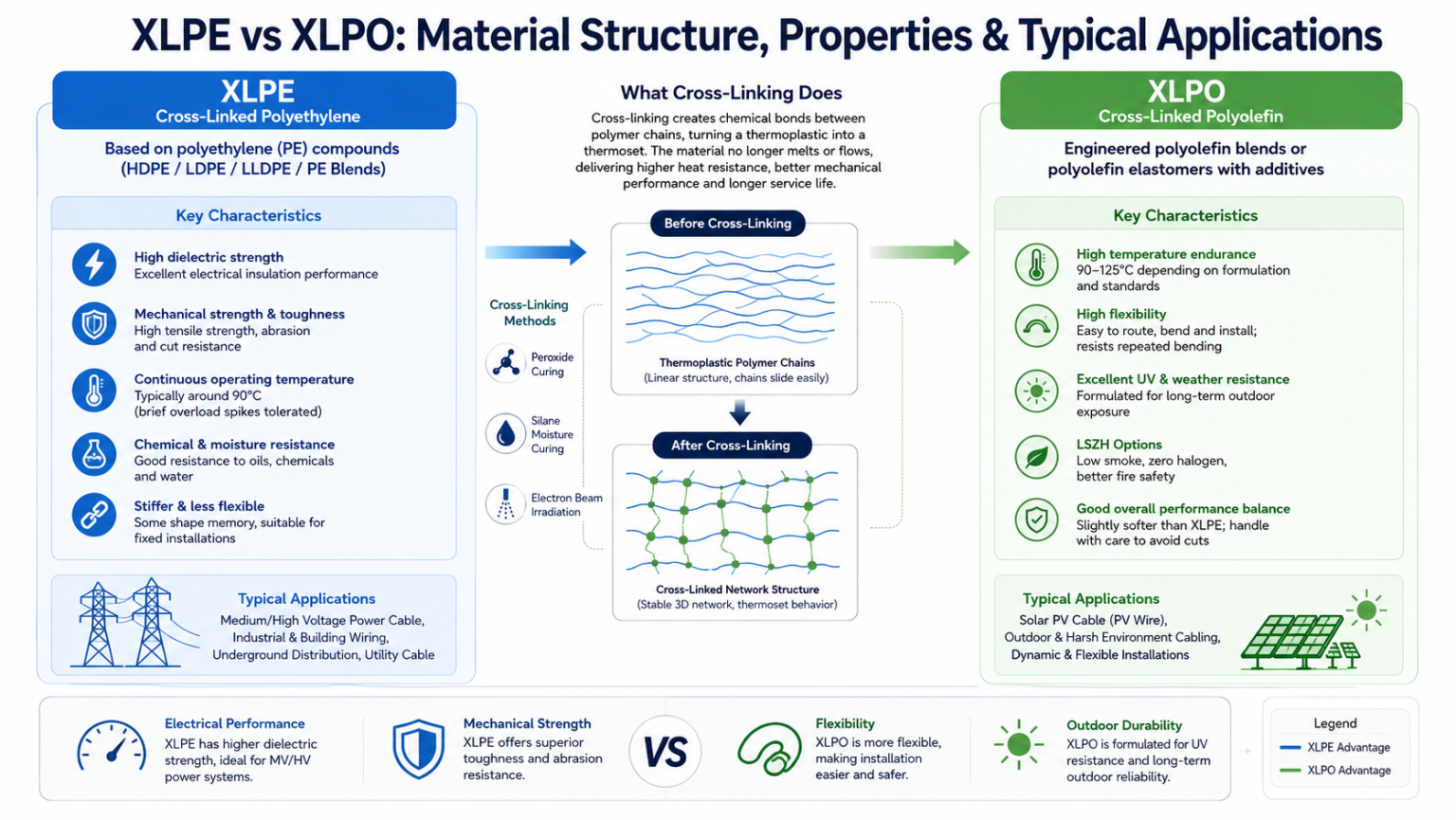
Both XLPE and XLPO start life as a thermoplastic — a polymer that softens when heated and hardens again when cooled, with individual polymer chains sliding freely past one another. Cross-linking changes that behavior permanently. Cross-linking can be achieved through several industrial processes, including peroxide curing, silane moisture curing, and electron-beam irradiation. The choice of process depends on the polymer formulation and the intended cable application. In photovoltaic (PV) cable manufacturing, electron-beam (EB) cross-linking is the most widely adopted process because it provides precise control over cross-link density without requiring chemical curing agents.
That network is what makes the insulation a thermoset instead of a thermoplastic. Once cross-linked, the material no longer melts in the traditional sense — it can still soften somewhat at high temperature, but it won't flow, drip, or lose its shape the way uncross-linked PVC or polyethylene will. This is the single biggest reason cross-linked polymers dominate solar cable: PV strings routinely see cable surface temperatures well above what plain PVC insulation can tolerate without deforming.
XLPE: Cross-Linked Polyethylene
XLPE is based on polyethylene (PE) compounds, which may include HDPE, LDPE, LLDPE, or engineered polyethylene blends depending on the cable design. After cross-linking, the material becomes a thermoset insulation with excellent electrical and mechanical performance. Polyethylene's own molecular structure is already fairly linear and tightly packed, which gives XLPE a set of predictable mechanical and electrical characteristics once the cross-linking step is complete.
Mechanical and electrical behavior
- High tensile strength and stiffness, giving strong resistance to cuts, abrasion, and crushing forces.
- Excellent dielectric strength and low dielectric loss, which is why XLPE has long been the standard insulation for medium- and high-voltage power cable.
- Continuous operating temperature typically around 90°C, with the ability to tolerate brief overload spikes.
- Good chemical, oil, and moisture resistance, useful in industrial and utility settings.
- Less flexible than XLPO and can exhibit "shape memory," tending to hold whatever curve or coil it was formed into.
Because of this profile, XLPE remains a workhorse for fixed power distribution wiring, switchgear interconnects, and general building or industrial cable — anywhere electrical performance and mechanical toughness matter more than flexibility or outdoor UV survivability.
XLPO: Cross-Linked Polyolefin
XLPO (Cross-Linked Polyolefin) is a broader material family rather than a single polymer. Polyethylene itself belongs to the polyolefin family, meaning XLPE can technically be considered one type of XLPO. However, in the wire and cable industry, the term "XLPO" is commonly used to describe specially formulated cross-linked polyolefin compounds designed for applications requiring enhanced flexibility, UV resistance, and thermal stability—particularly photovoltaic (PV) cables.
These compounds are typically based on engineered polyolefin blends or polyolefin elastomers combined with UV stabilizers, antioxidants, flame retardants, and other performance-enhancing additives. Most solar-grade XLPO compounds are cross-linked using electron-beam irradiation.
Mechanical and electrical behavior
- Depending on the formulation and applicable standards, solar-grade XLPO compounds can provide continuous operating temperature ratings ranging from 90°C to 125°C. Compared with conventional XLPE formulations, they generally offer greater thermal endurance for demanding outdoor environments.
- Significantly more flexible than XLPE, which matters when cables have to be routed through tight junction boxes, along module frames, or bent repeatedly during installation.
- Formulated for long-term UV and weathering resistance, since the additive package is built around outdoor survival rather than indoor electrical performance.
- Frequently produced as low-smoke, zero-halogen (LSZH) compounds, which matters for fire safety in enclosed or densely packed installations.
- Slightly softer than XLPE, so it can be marginally more susceptible to cuts and abrasion if not sheathed or routed carefully.
This combination — high heat tolerance, flexibility, and engineered UV resistance — is precisely the profile a PV array demands, which is why XLPO insulation has become the de facto standard for dedicated solar cable such as H1Z2Z2-K and similar PV wire designations.
XLPO vs XLPE: Side-by-Side Comparison
|
Property |
XLPE (Cross-Linked Polyethylene) |
XLPO (Cross-Linked Polyolefin) |
|
Base resin |
Standard polyethylene (PE / HDPE) |
Polyolefin elastomer or engineered polyolefin blend |
|
Continuous operating temperature |
Around 90°C, with brief spikes tolerated |
90–125°C (depending on formulation and applicable standards) |
|
Flexibility |
Stiffer; some shape memory |
More pliable, easier to route and bend |
|
Dielectric strength |
Very high; strong choice for MV/HV work |
High, though sometimes slightly behind XLPE |
|
UV & weathering resistance |
Good, but can be outperformed outdoors |
Formulated for long-term outdoor UV exposure |
|
Abrasion / cut resistance |
Tough and rigid, resists physical damage well |
Good, but generally softer than XLPE |
|
Halogen content |
Varies by formulation |
Commonly formulated as low-smoke, zero-halogen (LSZH) |
|
Relative cost |
Generally lower material cost |
Generally higher compound cost |
|
Typical use case |
Fixed installations, MV/HV power distribution |
Solar PV strings, dynamic and harsh-environment cabling |
Why It Matters for Solar Installations Specifically
A PV string cable isn't a typical fixed-installation wire. It sits fully exposed to direct sunlight for decades, cycles between freezing nighttime temperatures and scorching midday surface heat, and often gets flexed during installation, maintenance, or repositioning. Each of those conditions stresses insulation in a different way, and it's where the two materials' design priorities diverge most clearly.
UV and long-term weathering
UV resistance depends primarily on the compound formulation rather than the base polymer itself. Conventional XLPE formulations used in power cables are generally optimized for electrical insulation performance, whereas solar-grade XLPO compounds incorporate enhanced UV stabilizers specifically designed for prolonged outdoor exposure.
Temperature swings
Solar module junction boxes and cable trays can reach very high surface temperatures on a sunny day, then drop sharply after sunset. XLPO's higher continuous-temperature rating gives installers more margin before the insulation starts to degrade, particularly in rooftop or desert utility-scale sites where ambient and reflected heat both push cable temperatures upward.
Installation flexibility
Solar cable is frequently bent around module frames, threaded through cable glands, and coiled during transport and storage. The engineered elastomeric components used in many XLPO compounds provide greater flexibility and improved resistance to repeated bending compared with conventional XLPE formulations. This helps reduce installation stress and minimizes the risk of insulation damage during routing.
When XLPE Still Makes Sense
XLPO is not a universal upgrade, and the material science bears that out. XLPE's higher dielectric strength and superior mechanical toughness still make it the better fit for static, high-voltage power distribution where cables are protected from direct UV exposure and constant flexing. In those fixed installations, paying a premium for XLPO's flexibility and weather resistance adds cost without adding meaningful benefit. Choosing between the two ultimately comes down to matching the polymer's engineered strengths to the cable's actual operating environment, not treating one material as categorically "better."
Frequently Asked Questions
Is XLPO the same thing as XLPE?
No. XLPE is cross-linked polyethylene, a specific polymer built from standard PE resin. XLPO refers to cross-linked polyolefin compounds, while XLPE refers specifically to cross-linked polyethylene. Since polyethylene is itself a type of polyolefin, XLPE can technically be regarded as one member of the broader XLPO family. However, within the cable industry, "XLPO" typically refers to specially formulated polyolefin compounds optimized for solar cables, offering enhanced flexibility, UV resistance, and weatherability compared with conventional XLPE formulations.
Is XLPO always better than XLPE for solar cable?
For dedicated outdoor PV string wiring, XLPO's UV resistance, higher temperature rating, and flexibility generally make it the preferred choice. But "better" depends on the application — for fixed, protected, high-voltage power runs, XLPE's dielectric performance and mechanical toughness can still be the right call.
Does XLPO cost more than XLPE?
Typically, yes. Solar-grade XLPO compounds typically cost more than conventional XLPE compounds because they use specialized polyolefin formulations together with UV stabilizers, antioxidants and other performance-enhancing additives.
How long does XLPO solar cable insulation last outdoors?
Solar-grade XLPO insulation is formulated to match the typical 25-to-30-year design life of a photovoltaic system, resisting UV-driven cracking and embrittlement over that period when installed and rated correctly for the site conditions.
Why Are XLPO and Electron-Beam Cross-Linking Often Mentioned Together?
Although XLPO describes a material family rather than a manufacturing process, the two terms are frequently associated in the photovoltaic industry. Most solar cable manufacturers use electron-beam (EB) irradiation to cross-link XLPO compounds because the process produces consistent cross-link density, excellent thermal performance, and high productivity without chemical curing agents.
By contrast, conventional XLPE power cables are more commonly produced using peroxide or silane cross-linking processes. Therefore, the industry often associates XLPO with EB cross-linking and XLPE with chemical cross-linking, even though either material can theoretically be cross-linked using different methods.
Key Takeaways
- Both XLPE and XLPO become thermoset insulation materials after cross-linking. Depending on the application, cross-linking may be achieved through peroxide curing, silane moisture curing, or electron-beam irradiation.
- XLPE is a specific cross-linked polyethylene material widely used in power cables because of its excellent electrical insulation and mechanical strength.
- In the PV industry, XLPO usually refers to specially formulated cross-linked polyolefin compounds that offer enhanced flexibility, UV resistance, weatherability, and high-temperature performance for long-term outdoor service.
- Choosing between them is a matter of matching material properties to the installation environment, not picking a universally "best" option.

- +86-13588204183
- No. 39 Zhiyuan Road, Deqing Economic Development Zone, Huzhou City, Zhejiang Province

Copyright © Zhejiang Huapu Cable Co., Ltd. All Rights Reserved.
 ISO 9001 Cable Manufacturer