
 en
en English
 中文简体
中文简体 русский
 Español
 عربى
عربى
AD7 vs AD8 Solar Cables: What's the Difference and Which One Should You Choose?
Content
Introduction
As the global photovoltaic (PV) industry continues to expand, solar cable performance plays a critical role in ensuring the safety, reliability, and long-term performance of solar power systems.
Modern PV cables are expected to operate for more than 25 years while continuously exposed to:
- UV radiation
- Heavy rain
- Temperature fluctuations
- Mechanical stress
- Outdoor weather conditions
In recent years, AD7 and AD8 have become common terms in the European solar market, especially for floating photovoltaic (FPV), agricultural PV, and coastal solar projects.
But what do these ratings actually mean? Are they cable standards, or simply installation classifications?
This guide explains the differences between AD7 and AD8 from the perspectives of materials, cable construction, waterproof performance, and typical applications.
AD7 vs AD8 at a Glance
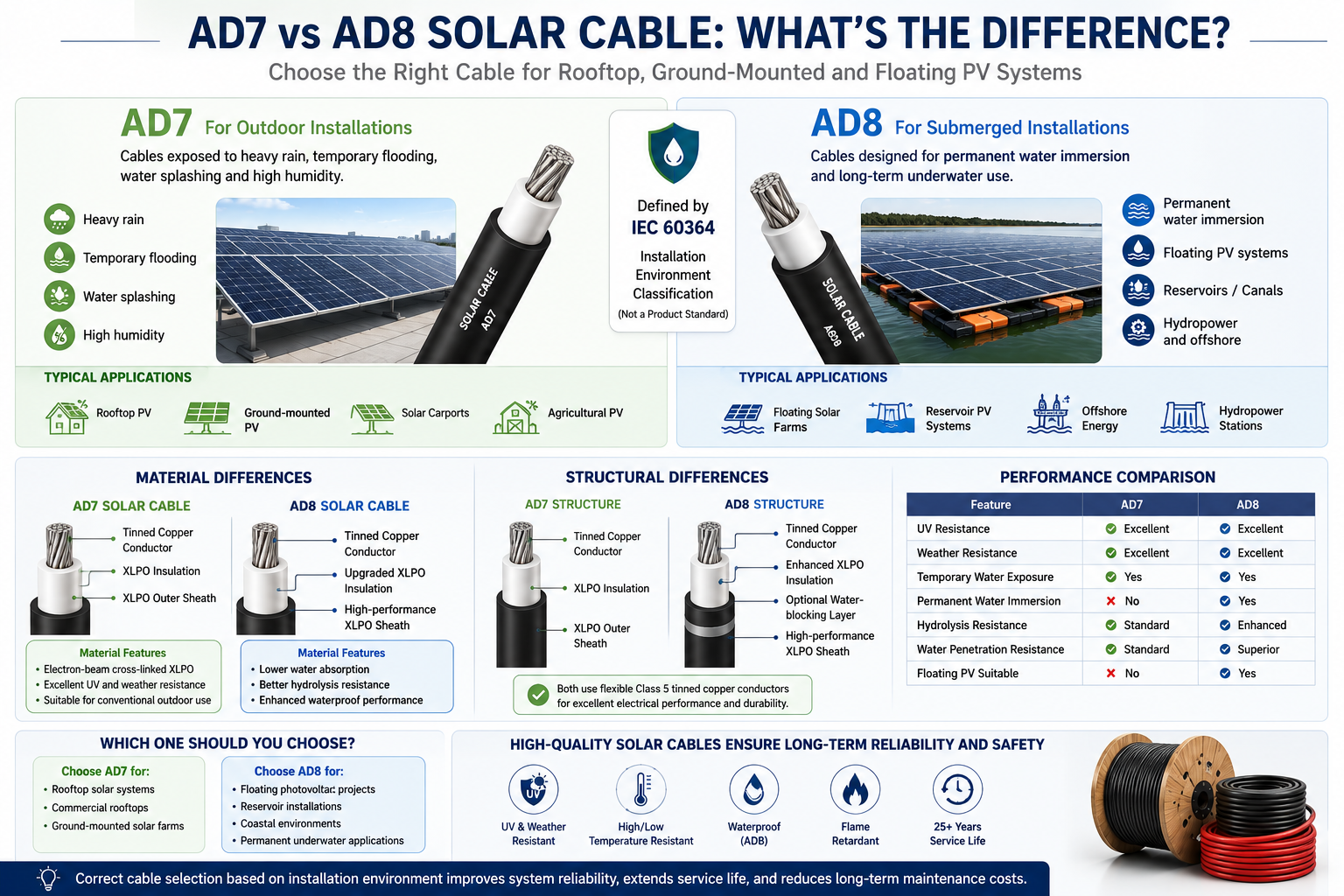
AD7 and AD8 are installation environment classifications defined by IEC 60364, not product certification standards.
The key difference is the level of water exposure.
| AD7 | AD8 |
|---|---|
| Heavy rain | Permanent water immersion |
| Temporary flooding | Floating PV systems |
| Water splashing | Reservoir installations |
| High humidity | Underwater environments |
What Is AD7?
AD7 is intended for outdoor environments where cables are frequently exposed to moisture but are not permanently submerged.
Typical Applications
- Rooftop solar systems
- Ground-mounted PV plants
- Solar carports
- Agricultural PV projects
Environmental Conditions
- Heavy rain
- Temporary flooding
- Water splashing
- High humidity
A properly designed AD7 installation can withstand long-term outdoor exposure but is not intended for continuous underwater operation.
What Is AD8?
AD8 is designed for much harsher environments where cables may remain in contact with water for extended periods.
Typical Applications
- Floating photovoltaic (FPV) systems
- Reservoir solar farms
- Offshore renewable energy projects
- Irrigation canals
- Hydropower stations
Unlike AD7, AD8 installations require cables that maintain electrical performance even after long-term water exposure.
Why Standard Solar Cables Cannot Always Meet AD8 Requirements
Many standard PV cables comply with internationally recognized standards such as:
- EN 50618
- IEC 62930
- TÜV PV Certification
These cables already provide excellent:
- UV resistance
- Weather resistance
- Ozone resistance
- Flame retardancy
- High-temperature performance
However, compliance with these standards does not automatically guarantee long-term underwater performance.
Continuous immersion introduces additional challenges, including:
- Water penetration into polymer materials
- Accelerated insulation aging
- Reduced dielectric strength
- Corrosion of metallic components
- Mechanical degradation
For this reason, AD8 applications require additional engineering beyond conventional PV cable designs.
Material Differences
AD7 Solar Cable
Most AD7 solar cables use electron-beam cross-linked XLPO insulation.
Key characteristics include:
- Excellent UV resistance
- High temperature resistance
- Good flexibility
- Long outdoor service life
These materials perform well in conventional outdoor solar installations.
AD8 Solar Cable
Compared with AD7, AD8 cables typically incorporate upgraded material formulations, including:
- Lower water absorption
- Enhanced hydrolysis resistance
- Improved water-blocking performance
- Higher-density cross-linked XLPO compounds
These improvements help prevent long-term moisture penetration and maintain electrical reliability.
Sheath Material Comparison
The outer sheath serves as the cable's primary environmental protection layer.
| AD7 Sheath | AD8 Sheath |
|---|---|
| UV resistant | Lower water permeability |
| Weather resistant | Enhanced hydrolysis resistance |
| Abrasion resistant | Improved chemical resistance |
| Ozone resistant | Better microbial and algae resistance |
The enhanced sheath formulation is one of the major reasons AD8 cables perform better in submerged environments.
Structural Differences
Although AD7 and AD8 cables often appear similar externally, their internal construction may differ significantly.
Typical AD7 Construction
- Class 5 tinned copper conductor
- XLPO insulation
- XLPO outer sheath
This structure offers excellent flexibility and weather resistance.
Typical AD8 Construction
- Class 5 tinned copper conductor
- Enhanced XLPO insulation
- Optional water-blocking layer
- High-performance XLPO outer sheath
- Improved sealing structure
These design enhancements reduce water penetration and improve long-term durability.
Waterproof Performance Testing
Standard photovoltaic cables typically undergo:
- Insulation resistance testing
- High-voltage testing
- UV aging
- Weather resistance testing
- Thermal cycling
AD8 applications often require additional testing, such as:
- Long-term water immersion
- Water penetration testing
- Pressure water testing
- Accelerated aging after immersion
- Electrical performance verification following submersion
Depending on project requirements, these evaluations may last several months.
Performance Comparison
| Property | AD7 | AD8 |
|---|---|---|
| UV Resistance | Excellent | Excellent |
| Weather Resistance | Excellent | Excellent |
| Temporary Water Exposure | Yes | Yes |
| Permanent Water Immersion | No | Yes |
| Hydrolysis Resistance | Standard | Enhanced |
| Water Penetration Resistance | Standard | Superior |
| Suitable for Floating PV | No | Yes |
Which Cable Should You Choose?
AD7 is recommended for:
- Residential rooftop PV systems
- Commercial rooftop projects
- Ground-mounted solar farms
- Industrial photovoltaic installations
AD8 is recommended for:
- Floating solar farms
- Reservoir PV projects
- Coastal environments
- Permanent underwater installations
Selecting AD8 for standard rooftop systems generally increases project costs without providing significant additional value.
Future Outlook
Floating photovoltaic power stations are expected to grow rapidly over the coming decade due to:
- More efficient land utilization
- Reduced water evaporation
- Improved solar module efficiency through natural cooling
- Better integration with hydropower infrastructure
As floating PV continues to expand, demand for high-performance waterproof solar cables and advanced insulation materials will also increase.
Conclusion
The difference between AD7 and AD8 extends far beyond waterproof performance.
While both are suitable for outdoor photovoltaic installations, AD8 cable systems are specifically engineered for permanent water immersion through enhanced materials, optimized cable construction, and more demanding waterproof testing.
For conventional rooftop and ground-mounted PV systems, certified EN 50618 or IEC 62930 solar cables remain the preferred solution. However, for floating photovoltaic projects and other submerged environments, AD8-rated cable solutions provide the long-term reliability required for decades of safe operation.
Selecting the appropriate cable based on the installation environment is essential for maximizing system reliability, extending service life, and reducing maintenance costs.

- +86-13588204183
- No. 39 Zhiyuan Road, Deqing Economic Development Zone, Huzhou City, Zhejiang Province

Copyright © Zhejiang Huapu Cable Co., Ltd. All Rights Reserved.
 ISO 9001 Cable Manufacturer