
 en
en English
 中文简体
中文简体 русский
 Español
 عربى
عربى
Why "Ordinary" PV Cable Fails Long-Term UV Exposure Tests
Focus Keyword: UV Resistant Solar Cable
Secondary Keywords: Solar Cable, PV Cable, Photovoltaic Cable, XLPO Solar Cable, H1Z2Z2-K Cable, EN 50618 Solar Cable, IEC 62930 Solar Cable, DC Solar Cable, Tinned Copper Cable
Meta Description: Discover why ordinary PV cables fail long-term UV exposure tests, how ultraviolet radiation degrades cable materials, and why certified XLPO solar cables deliver superior outdoor performance for photovoltaic systems.
Estimated Reading Time: 8–10 Minutes
Introduction
When discussing the lifespan of a photovoltaic (PV) system, most attention is given to solar panels, inverters, and mounting structures. However, one critical component is often overlooked—the solar cable.
A typical photovoltaic system is designed to generate clean energy for 25 to 30 years. During this period, PV cables remain exposed to direct sunlight every day, enduring ultraviolet (UV) radiation, high temperatures, rain, humidity, ozone, and continuous thermal cycling.
Unfortunately, not every cable marketed as a "PV cable" is capable of surviving these harsh conditions. Many low-cost products perform well during installation but begin to crack, harden, or lose electrical performance after only a few years outdoors.
So why do ordinary PV cables fail long-term UV exposure tests while certified solar cables continue operating reliably for decades?
The answer lies in material science, manufacturing technology, and international testing standards.
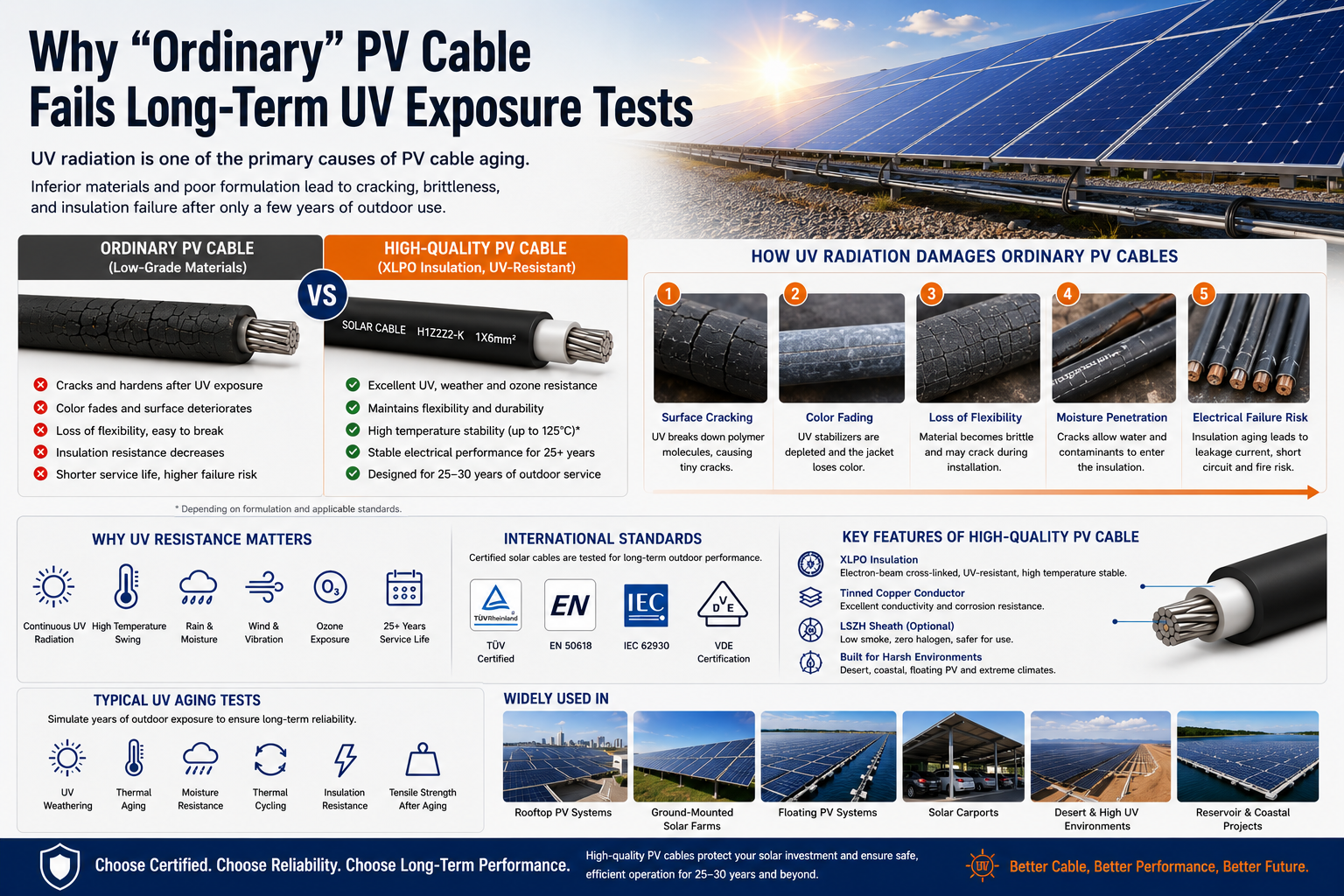
Why UV Resistance Is Critical for Solar Cables
Unlike building wires installed inside walls or conduits, solar cables are continuously exposed to sunlight throughout their entire service life.
Every day, a PV cable experiences multiple environmental stresses, including:
- Continuous ultraviolet radiation
- High ambient temperatures
- Rain and moisture
- Ozone exposure
- Wind-induced movement
- Daily thermal expansion and contraction
Over thousands of heating and cooling cycles, these factors gradually accelerate material aging.
For rooftop PV systems, floating solar farms, desert solar plants, and utility-scale photovoltaic projects, UV resistance is one of the most important indicators of cable quality.
How UV Radiation Damages Ordinary PV Cables
Ultraviolet radiation contains high-energy photons capable of breaking the molecular chains inside polymer insulation and cable jackets.
Unlike mechanical damage, UV degradation occurs slowly and often goes unnoticed until significant deterioration has already taken place.
Typical signs include:
Surface Cracking
Tiny cracks gradually appear on the cable sheath, allowing moisture and contaminants to penetrate into the insulation.
Color Fading
Black cable jackets slowly turn gray or brown as UV stabilizers are consumed.
Although fading itself does not immediately affect electrical performance, it is often an early indication of material aging.
Loss of Flexibility
As polymer chains degrade, the cable becomes increasingly brittle.
Installation stress, vibration, or cable movement may eventually cause the outer jacket to split.
Reduced Electrical Insulation
As insulation deteriorates, dielectric strength decreases, increasing the possibility of leakage current, insulation breakdown, and system failure.
Why Some PV Cables Fail Much Earlier Than Others
Many buyers assume all photovoltaic cables are manufactured using the same materials.
In reality, significant differences exist.
Lower-cost products often reduce manufacturing costs by using:
- Lower-grade polymer compounds
- Insufficient UV stabilizers
- Inferior antioxidant additives
- Poor cross-linking processes
- Lower-quality carbon black dispersion
Initially, these cables may appear almost identical to certified products.
However, after years of outdoor exposure, their mechanical and electrical properties deteriorate much faster.
This explains why two solar installations built at the same time can experience dramatically different cable lifespans.
Why XLPO Has Become the Preferred Material for Solar Cables
Most premium PV cables today use electron-beam cross-linked XLPO (Cross-linked Polyolefin) instead of ordinary thermoplastic insulation.
Compared with conventional materials, XLPO offers several important advantages:
- Excellent UV resistance
- Outstanding weather resistance
- High temperature stability
- Superior ozone resistance
- Excellent flexibility
- Long-term mechanical durability
More importantly, electron-beam cross-linking creates a stronger molecular structure, enabling the insulation to maintain its properties even after decades of outdoor exposure.
For this reason, modern H1Z2Z2-K cables, EN 50618 solar cables, and IEC 62930 photovoltaic cables are typically manufactured using XLPO compounds.
UV Resistance Depends on More Than the Base Material
One of the biggest misconceptions in the solar industry is that UV performance depends solely on whether the cable uses XLPE or XLPO.
In reality, the compound formulation is equally important.
A high-quality solar cable typically incorporates:
- UV stabilizers
- Antioxidants
- Carbon black with optimized dispersion
- Weather-resistant additives
- Heat stabilizers
Even two cables using the same base polymer may perform very differently if their formulations or manufacturing processes are different.
This is why certified manufacturers invest heavily in material development and quality control.
International Standards That Verify UV Performance
Reliable photovoltaic cables are tested according to internationally recognized standards before entering the market.
Common standards include:
- EN 50618
- IEC 62930
- TÜV Certified PV Cable
- H1Z2Z2-K
- PV1-F
These standards evaluate multiple performance characteristics, including:
- UV resistance
- Weather aging
- Flame retardancy
- Thermal endurance
- Ozone resistance
- Mechanical durability
- Electrical safety
Compliance with these standards provides greater confidence that a cable can withstand decades of outdoor operation.
How UV Exposure Tests Are Performed
Manufacturers do not simply expose cables to sunlight and wait for years.
Instead, laboratories use accelerated aging equipment to simulate long-term outdoor conditions.
Typical tests include:
- Accelerated UV weathering
- Thermal aging
- Ozone resistance
- Moisture resistance
- Thermal cycling
- Insulation resistance testing
- Tensile strength after aging
- Elongation testing
These evaluations help predict long-term performance while significantly reducing testing time.
Why UV Resistance Matters More Than Ever
Modern photovoltaic projects are expanding far beyond traditional rooftop installations.
Today's solar cables are increasingly used in:
- Desert solar farms
- Floating photovoltaic (FPV) systems
- Coastal renewable energy projects
- High-altitude installations
- Tropical climates with intense UV radiation
These environments demand much higher levels of environmental resistance than conventional electrical applications.
As global solar capacity continues to grow, selecting a UV-resistant solar cable is no longer simply a quality preference—it has become an essential requirement for ensuring system reliability over the entire project lifecycle.
How to Choose a High-Quality Solar Cable
When evaluating a PV cable, engineers and procurement teams should consider more than price alone.
Key selection criteria include:
Certified Standards
Choose products certified to EN 50618, IEC 62930, or equivalent international standards.
Insulation Material
Electron-beam cross-linked XLPO offers significantly better outdoor durability than ordinary thermoplastic materials.
Conductor Quality
Tinned copper conductors provide superior corrosion resistance and stable electrical conductivity.
Manufacturer Experience
An experienced solar cable manufacturer is more likely to maintain consistent material quality, process control, and product traceability.
Application Environment
Projects located in deserts, coastal regions, or floating PV systems require even greater UV and weather resistance.
Frequently Asked Questions
Can ordinary PVC cable be used for photovoltaic systems?
No. Standard PVC cable is not designed for decades of continuous UV exposure and generally cannot meet photovoltaic installation requirements.
Does a black cable always have better UV resistance?
Not necessarily. UV performance depends primarily on material formulation and stabilizer technology rather than color alone.
Which standards indicate good UV resistance?
EN 50618, IEC 62930, TÜV certification, and H1Z2Z2-K specifications are widely recognized benchmarks for photovoltaic cable performance.
Conclusion
Long-term UV resistance is one of the most critical factors affecting the reliability of a photovoltaic system.
Ordinary PV cables often fail because they use lower-grade materials, insufficient UV stabilizers, and simplified manufacturing processes that cannot withstand decades of outdoor exposure.
Certified solar cables, manufactured with XLPO insulation, tinned copper conductors, and tested according to EN 50618 and IEC 62930, provide significantly better protection against ultraviolet radiation, weathering, and environmental aging.
For EPC contractors, distributors, installers, and project developers, investing in high-quality photovoltaic cables is not simply about meeting specifications—it is about protecting the long-term performance, safety, and return on investment of every solar project.

- +86-13588204183
- No. 39 Zhiyuan Road, Deqing Economic Development Zone, Huzhou City, Zhejiang Province

Copyright © Zhejiang Huapu Cable Co., Ltd. All Rights Reserved.
 ISO 9001 Cable Manufacturer