
 en
en English
 中文简体
中文简体 русский
 Español
 عربى
عربى
Tube Extrusion vs. Pressure Extrusion Cable Sheathing: A Practical Comparison Guide
Meta Description: Learn the key differences between tubing (tube-on/jacketing) extrusion and pressure extrusion for cable sheathing, including tooling, core contact, production characteristics, performance, and typical applications.
Focus Keywords: cable sheathing process, tube extrusion sheathing, pressure extrusion sheathing, wire and cable jacketing, extruded cable jacket, PVC cable sheath extrusion
Introduction
Cable sheathing, also called jacketing, is a critical step in wire and cable manufacturing. The extrusion method and tooling configuration influence the jacket's geometry, material usage, stripability, interaction with the cable core, and production efficiency. The final cable's mechanical, environmental, and flexibility performance, however, also depends on the cable construction, compound, wall thickness, and applicable standard.
Two commonly used approaches for thermoplastic cable jacketing are tubing (tube-on or jacketing) extrusion and pressure extrusion. The main difference is how the polymer melt approaches and contacts the cable core inside the extrusion head. In tubing extrusion, the melt leaves the tooling as a tube and is drawn down onto the core. In pressure extrusion, the melt contacts the core within the head and is forced into closer conformity with the core surface.
This guide compares the two methods from the perspective of process mechanics, core contact, tooling, production behavior, and typical cable applications. It is intended as a practical reference for cable manufacturers, engineers, and procurement teams.
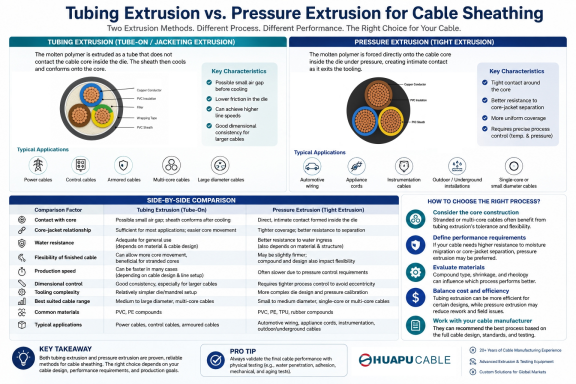
What Is Tubing (Tube-On / Jacketing) Extrusion?
In tubing extrusion, the extrusion head is configured so that the polymer forms a tube before reaching the final cable surface. The cable core passes through the center of this tube, and the extruded material is drawn down onto the core as the line runs through the tooling and cooling section. This method is commonly used when a relatively loose or easily strippable jacket is preferred.
The term “tubing extrusion” is preferable to “loose tube extrusion” in this context because the latter can be confused with the loose-tube construction used in fiber-optic cables.
Key characteristics:
- The polymer melt forms a tube and is drawn down onto the cable core rather than being forced into intimate contact with the core far upstream in the head.
- The larger tooling clearance generally reduces contact between the tooling and the core, which can simplify processing.
- It can provide good production efficiency and material economy when the cable design does not require strong adhesion between jacket and core.
- The resulting jacket can be easier to strip and can allow more relative movement between the jacket and the underlying cable core.
- Dimensional control depends on tooling, draw-down ratio, line speed, melt temperature, cooling conditions, and core tension; it is not inherently superior for every large cable.
Typical use cases:
- Outer jackets of multi-core power and control cables where a non-adhered or easily strippable jacket is acceptable
- Cable constructions where the jacket is intended primarily to provide mechanical and environmental protection
- Cables with complex or stranded core bundles where avoiding excessive pressure on the core is beneficial
- Applications where production efficiency and material economy are important
What Is Pressure Extrusion?
In pressure extrusion, the extrusion head is configured so that the polymer melt contacts the cable core inside the head before reaching the die exit. The melt is therefore under pressure around the core and can fill surface irregularities and interstices more effectively than a conventional tubing configuration.
Pressure extrusion does not automatically mean that the polymer chemically bonds to the core. “Intimate contact” or “tight coverage” is more accurate unless adhesion has specifically been engineered and verified.
Key characteristics:
- The melt contacts the core within the extrusion head and is forced into closer conformity with the core surface.
- It can provide better filling of surface irregularities and interstices in the core bundle.
- It is useful when a tight, compact jacket-to-core construction is required.
- It generally requires more precise control of tooling, temperature, pressure, line speed, and core centering.
- A tight extrusion can improve resistance to relative movement between the jacket and core, but overall mechanical and environmental performance still depends on the complete cable design.
Typical use cases:
- Single-core and small-to-medium diameter cables requiring tight coverage
- Flexible cables where the jacket is intended to hold the cable core together
- Automotive, appliance, instrumentation, and other applications where tight coverage or controlled core positioning is important
- Cable constructions where reduced voids and closer conformity around the core are required
Tube-On Extrusion vs. Pressure Extrusion: Side-by-Side Comparison
|
Comparison Factor |
Tubing (Tube-On / Jacketing) Extrusion |
Pressure Extrusion |
|
Melt/core relationship |
Polymer forms a tube and is drawn down onto the core near the die exit |
Polymer contacts the core inside the head and is forced into closer conformity |
|
Core contact |
Typically looser or non-adhered, depending on tooling and design |
Tighter, more intimate contact with the core |
|
Adhesion / bonding |
Generally lower when adhesion is not required |
Can provide stronger mechanical engagement, but true bonding depends on material and construction |
|
Void / interstice filling |
Less filling of core interstices |
Better filling of surface irregularities and interstices |
|
Stripability |
Generally easier to strip |
Can be more difficult to strip when tight coverage is required |
|
Core movement |
Allows more relative movement between jacket and core |
Restricts relative movement more strongly |
|
Production behavior |
Often efficient and economical; exact speed depends on material, tooling, and cable design |
Often requires tighter process control; output and speed depend strongly on tooling and material |
|
Dimensional control |
Can provide good jacket geometry, but depends strongly on draw-down and cooling conditions |
Can provide close conformity to the core, but eccentricity control requires careful centering and tooling setup |
|
Tooling |
Larger clearance / tubing-type tooling |
Pressure-type tooling with closer tip-to-core geometry |
|
Typical applications |
Outer jacketing of multi-core, control, communication, and other cables where loose or strippable coverage is acceptable |
Cables requiring tight coverage, controlled core positioning, or better filling of core irregularities |
How to Choose the Right Sheathing Process
Selecting between tubing extrusion and pressure extrusion is not simply a choice between a “better” and a “worse” process. The correct method depends on the cable construction, required jacket-to-core relationship, material, stripping requirements, production conditions, and applicable product standard.
- Choose tubing (tube-on/jacketing) extrusion when a relatively loose, easily strippable, or non-adhered outer jacket is acceptable and production efficiency or material economy is important.
- Choose pressure extrusion when tighter coverage, closer conformity to the core, better filling of surface irregularities, or controlled core positioning is required.
- Do not select the process solely by cable diameter. Core construction, material rheology, die design, draw-down ratio, line speed, and the required finished-cable performance can be more important than diameter alone.
- For waterproofing or moisture resistance, evaluate the complete cable construction and applicable test requirements. The extrusion method alone does not guarantee a waterproof cable.
Frequently Asked Questions
What is the main difference between tubing extrusion and pressure extrusion sheathing? Tubing extrusion forms the polymer into a tube and draws it down onto the cable core, while pressure extrusion brings the melt into contact with the core inside the extrusion head and forces it into closer conformity with the core.
Which method is easier to strip? Tubing extrusion generally produces a jacket that is easier to strip when the design does not require adhesion or tight coverage. Pressure extrusion can make stripping more difficult because the jacket conforms more closely to the core.
Which method offers better water resistance? Neither method by itself guarantees water resistance. Pressure extrusion can reduce voids and improve conformity around the core, but the cable's overall water resistance depends on the jacket material, construction, interfaces, fillers, tapes, and the relevant test requirements.
Is tubing extrusion suitable for all cable types? No. It is particularly useful where a loose or strippable outer jacket is acceptable. The final choice should be based on cable construction, material, tooling, and the required performance rather than cable type alone.
Does pressure extrusion reduce cable flexibility? It can restrict relative movement between the jacket and core, but overall cable flexibility is determined by the complete construction, including conductor stranding, lay length, fillers, tapes, jacket material, and jacket thickness. Pressure extrusion does not automatically make a cable inflexible.
Conclusion
Tubing (tube-on/jacketing) extrusion and pressure extrusion are both established methods for applying polymer jackets to wires and cables. Tubing extrusion is often advantageous when a relatively loose, strippable jacket, efficient production, or reduced interaction with the core is desired. Pressure extrusion is useful when closer conformity, tighter core coverage, and better filling of core irregularities are important.
The extrusion method should therefore be selected as part of the overall cable design rather than treated as a standalone indicator of cable quality. Material selection, tooling design, draw-down ratio, line speed, cooling, core construction, jacket thickness, and the applicable product standard all contribute to the final cable's performance.

- +86-13588204183
- No. 39 Zhiyuan Road, Deqing Economic Development Zone, Huzhou City, Zhejiang Province

Copyright © Zhejiang Huapu Cable Co., Ltd. All Rights Reserved.
 ISO 9001 Cable Manufacturer