
 en
en English
 中文简体
中文简体 русский
 Español
 عربى
عربى
Cross-Linking Degree and Its Impact on PV Cable Heat Deformation Resistance
Content
Focus Keyword: Cross-Linked PV Cable
Secondary Keywords: XLPO Solar Cable, Heat Deformation Resistance, PV Cable, Solar Cable, Cross-Linking Degree, H1Z2Z2-K Cable, EN 50618, IEC 62930, Electron Beam Cross-Linking
Meta Description: Learn how the cross-linking degree affects the heat deformation resistance, mechanical strength, and service life of PV cables. Discover why proper cross-linking is essential for high-performance solar cable manufacturing.
Estimated Reading Time: 8–10 Minutes
Introduction
As photovoltaic (PV) systems are expected to operate reliably for more than 25 years, the quality of every component—including the solar cable—is crucial to overall system performance.
While engineers often focus on conductor size, insulation thickness, or voltage rating, one critical factor is frequently overlooked: the cross-linking degree of the insulation material.
The cross-linking degree directly influences a PV cable's ability to withstand high temperatures, resist deformation, maintain electrical insulation, and ensure long-term durability in harsh outdoor environments.
In this article, we'll explain what cross-linking is, why it matters, how it affects heat deformation resistance, and what manufacturers do to ensure consistent cable quality.
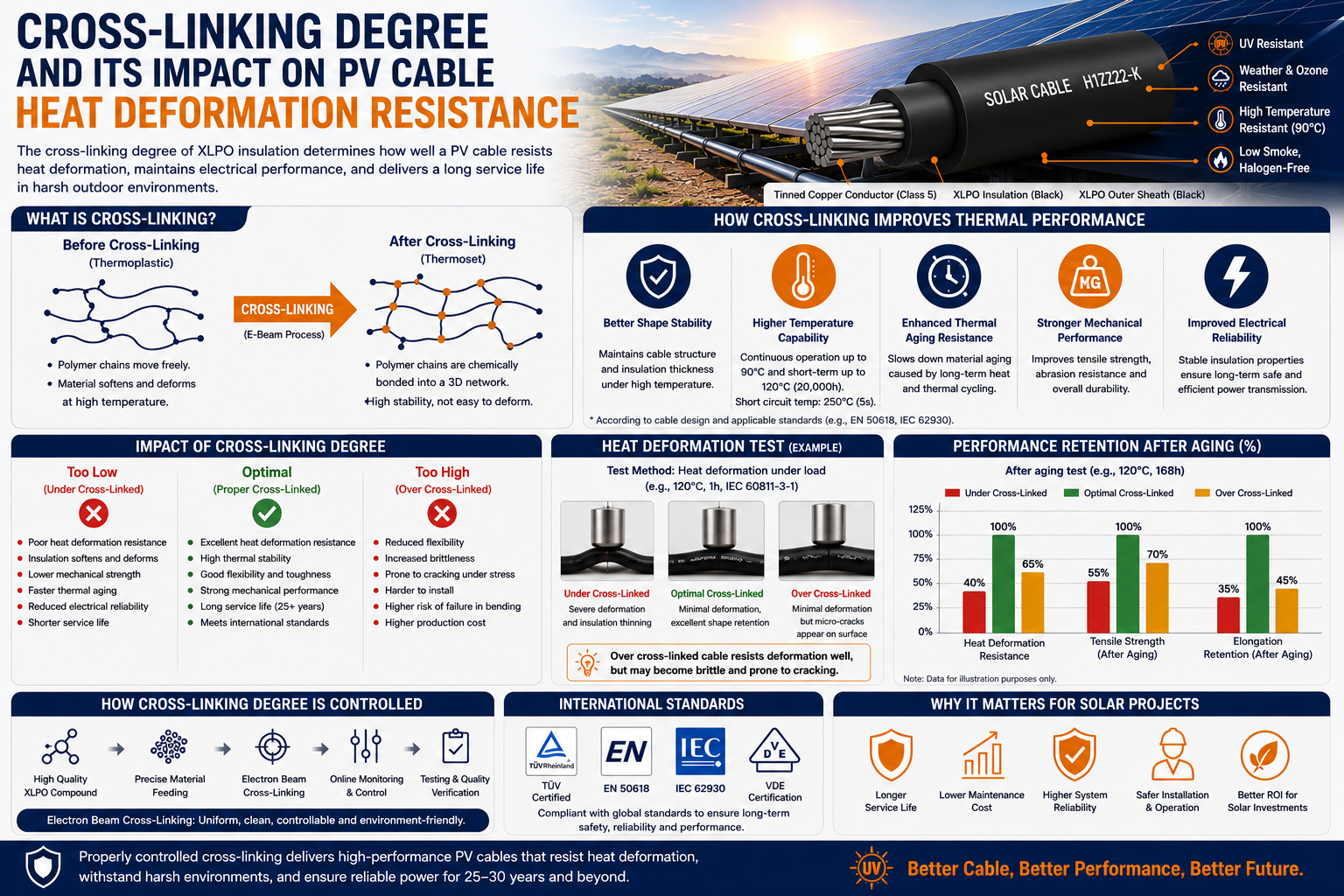
What Is Cross-Linking?
Cross-linking is a process that chemically or physically bonds polymer molecular chains together to form a three-dimensional network.
Unlike ordinary thermoplastic materials, which soften when heated, cross-linked materials maintain their shape and mechanical strength even at elevated temperatures.
This is why most modern solar cables, including H1Z2Z2-K, EN 50618, and IEC 62930 compliant products, use cross-linked polyolefin (XLPO) insulation.
Why Cross-Linking Degree Matters
The cross-linking degree refers to how completely the polymer molecules are interconnected during the manufacturing process.
A higher cross-linking degree generally results in:
- Better heat deformation resistance
- Improved dimensional stability
- Higher mechanical strength
- Enhanced chemical resistance
- Better long-term aging performance
However, excessive cross-linking can also reduce flexibility, making process control essential.
Understanding Heat Deformation Resistance
Heat deformation resistance describes a cable's ability to retain its shape when subjected to elevated temperatures and mechanical load.
During operation, PV cables may experience:
- High ambient temperatures
- Direct solar radiation
- Elevated conductor temperatures caused by electrical current
- Long-term thermal cycling
If the insulation softens excessively, the cable may deform, reducing insulation thickness and potentially compromising electrical safety.
A properly cross-linked insulation layer helps prevent this deformation.
How Cross-Linking Improves Thermal Performance
Cross-linked polymer structures provide several thermal advantages.
Improved Shape Stability
Unlike ordinary thermoplastics, XLPO insulation does not easily soften under high temperatures.
This allows the cable to maintain its original geometry during continuous operation.
Higher Operating Temperature
Well-manufactured cross-linked PV cables typically support continuous operating temperatures of 90°C and short-term overload temperatures up to 120°C, depending on the product design and applicable standards.
Better Resistance to Thermal Aging
Repeated heating and cooling gradually degrade polymer materials.
Cross-linked insulation slows this aging process, helping the cable retain its electrical and mechanical properties throughout its service life.
What Happens If the Cross-Linking Degree Is Too Low?
Insufficient cross-linking can significantly reduce cable performance.
Possible consequences include:
- Excessive insulation deformation
- Reduced tensile strength
- Lower abrasion resistance
- Faster thermal aging
- Reduced electrical reliability
- Shortened service life
Although these defects may not be visible immediately after production, they often appear after years of outdoor operation.
Can Cross-Linking Degree Be Too High?
Yes.
While higher cross-linking generally improves heat resistance, excessive cross-linking may introduce new challenges.
Potential issues include:
- Reduced flexibility
- Increased brittleness
- More difficult cable installation
- Higher manufacturing costs
For this reason, manufacturers carefully optimize the cross-linking process to achieve the best balance between flexibility and thermal performance.
How Is Cross-Linking Degree Controlled?
Modern solar cable manufacturers typically use electron beam (E-beam) cross-linking technology.
Compared with traditional chemical cross-linking, electron beam processing offers several advantages:
- Uniform cross-linking throughout the insulation
- No chemical cross-linking residues
- Better process consistency
- Improved environmental performance
- Higher production efficiency
Strict process control helps ensure every batch meets international quality requirements.
Heat Deformation Testing
To verify insulation quality, manufacturers perform heat deformation tests according to international standards.
Typical evaluations include:
- Heat deformation testing
- Hot set testing
- Tensile strength measurement
- Elongation testing
- Thermal aging tests
- Dimensional stability evaluation
These tests confirm that the insulation maintains its shape and performance under elevated temperatures.
International Standards
High-quality photovoltaic cables are commonly manufactured according to:
- EN 50618
- IEC 62930
- H1Z2Z2-K
- TÜV PV Certification
These standards specify performance requirements for:
- Heat resistance
- Mechanical properties
- Electrical insulation
- UV resistance
- Weather resistance
- Flame retardancy
- Long-term aging
Why This Matters for Solar Projects
As solar installations expand into deserts, tropical regions, floating photovoltaic systems, and utility-scale power plants, cables are subjected to increasingly demanding operating conditions.
Selecting a PV cable with properly controlled cross-linking ensures:
- Longer service life
- Better thermal stability
- Lower maintenance costs
- Improved installation reliability
- Higher system safety
For EPC contractors and project developers, investing in high-quality cross-linked solar cables helps protect the long-term performance of the entire photovoltaic system.
Frequently Asked Questions
What is the ideal cross-linking degree for PV cables?
There is no single universal value. The optimal cross-linking degree depends on the insulation material, manufacturing process, and applicable product standards. Manufacturers aim for a balanced level that provides both thermal resistance and flexibility.
Does a higher cross-linking degree always mean better quality?
Not necessarily. Excessive cross-linking may reduce flexibility and make installation more difficult. Proper process control is more important than simply maximizing the cross-linking degree.
Why is electron beam cross-linking widely used?
Electron beam technology provides more uniform cross-linking, excellent consistency, and cleaner production compared with traditional chemical cross-linking methods.
Conclusion
The cross-linking degree is one of the most important factors affecting the long-term performance of photovoltaic cables.
A well-controlled cross-linking process significantly improves heat deformation resistance, thermal aging performance, mechanical strength, and electrical reliability, allowing solar cables to operate safely for decades in challenging outdoor environments.
As demand for high-performance solar cables, XLPO cables, and H1Z2Z2-K photovoltaic cables continues to grow, manufacturers with advanced cross-linking technology and strict quality control will be better positioned to support the next generation of renewable energy projects.

- +86-13588204183
- No. 39 Zhiyuan Road, Deqing Economic Development Zone, Huzhou City, Zhejiang Province

Copyright © Zhejiang Huapu Cable Co., Ltd. All Rights Reserved.
 ISO 9001 Cable Manufacturer