
 en
en English
 中文简体
中文简体 русский
 Español
 عربى
عربى
Why HVDC is the Inevitable Choice
Content

As the global offshore wind industry moves into deeper and larger ocean territories, transmission technology is undergoing a profound shift from HVAC to HVDC. With its ultra-low long-distance attenuation and superior controllability, HVDC has become the only engineering choice for gigawatt-scale deep-sea projects.
The Physical Bottlenecks of HVAC
HVAC submarine cables generate massive capacitive charging currents over long distances, which not only consumes the space for active power transmission but also causes voltage instability. To offset this, platforms must install huge and expensive compensation equipment, making deep-sea projects financially unviable.
Core Advantages of HVDC
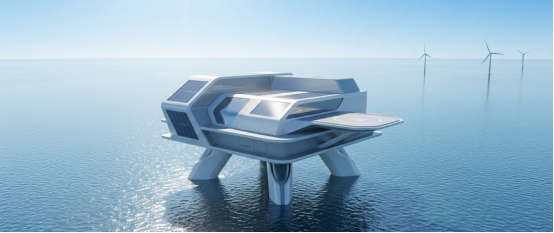
HVDC lacks an alternating magnetic field in steady-state operation, meaning no charging current is produced; its current-carrying capacity can be 100% utilized for active power. Advanced VSC-HVDC technology eliminates bulky AC filters, significantly reducing the footprint and weight of offshore platforms.
Economic Break-even & Future Trends
Although HVDC has high initial CapEx, once the distance crosses 50-120 km, its extremely low operational expenditure gives it an absolute advantage in overall LCOE. Landmark projects like China's Rudong (1100MW) and the UK's Dogger Bank (3600MW) have successfully applied this technology. The industry is now rapidly advancing towards 525kV ultra-high voltage and Multi-Terminal DC (MTDC) grids to reduce systemic downtime risks.
FAQ
Q1: Why can't offshore wind use common onshore AC transmission solutions?
A: Onshore transmission relies on overhead lines with low capacitance. Offshore wind requires buried submarine cables, whose high capacitance causes AC power to be congested by massive charging currents over long distances. Thus, DC transmission is mandatory.
Q2: Will massive offshore HVDC converter stations harm the marine ecosystem?
A: Magnetic and visual interference is minimal. However, converter platforms generate immense heat, and current open-loop cooling systems discharge warm water that may alter local temperatures. To resolve this, the industry is accelerating the commercialization of closed-loop cooling systems.

- +86-13588204183
- No. 39 Zhiyuan Road, Deqing Economic Development Zone, Huzhou City, Zhejiang Province

Copyright © Zhejiang Huapu Cable Co., Ltd. All Rights Reserved.
 ISO 9001 Cable Manufacturer