
 en
en English
 中文简体
中文简体 русский
 Español
 عربى
عربى
High-Density Data Center Fiber Selection Guide: Core Technical Differences and TCO Comparison Between OM4 and OM5
Content

In the evolution of global data centers toward 100G, 400G, and 800G network architectures, the choice of physical layer cabling media directly determines the performance and Total Cost of Ownership (TCO) of computing clusters. Within the multimode fiber (MMF) sequence for short-distance interconnections, OM4 and OM5 are currently the most widely deployed and cutting-edge solutions. Based on rigorous optical physics theories and international standards, this article provides a structured technical reference for media selection.
1. Core Physical Mechanisms and Wideband Characteristics
- OM4(Laser-Optimized Multimode Fiber):
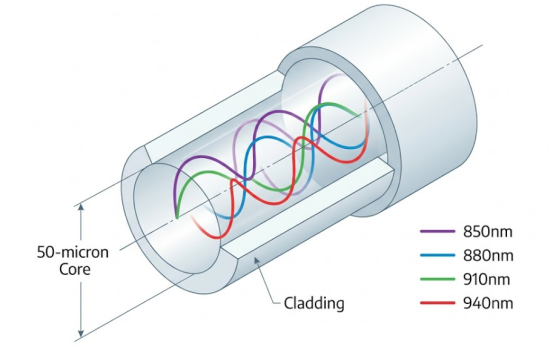
Its extremely high effective modal bandwidth is exclusively optimized and mandated for a single wavelength of 850nm (reaching 4700 MHz·km). Because modal dispersion increases sharply when deviating from the 850nm wavelength, OM4 must heavily rely on the Parallel Optics mechanism—linearly increasing the number of fiber channels—to achieve higher data rates.
- OM5(Wideband Multimode Fiber, WBMMF):
Without compromising 850nm performance, it additionally mandates a minimum bandwidth of 2470 MHz·km at the 953nm wavelength. This dispersion-flattened design is specifically engineered for Shortwave Wavelength Division Multiplexing (SWDM) and Bi-Directional (BiDi) transmission, enabling the lossless transmission of 4 wavelengths simultaneously within a single fiber, achieving up to a 75% physical reduction in fiber counts.
2. Key Technical Specifications and Identifications
|
Key Technical Indicators |
OM4/ OM4 Fiber |
OM5/ OM5 Fiber (WBMMF) |
|
International Standards |
TIA-492AAAD |
TIA-492AAAE, IEC 60793-2-10 |
|
Jacket Color (TIA-598-C) |
Aqua/Erika Violet |
Lime Green |
|
Core Optimized Light Source |
850nm VCSEL |
850nm-953nm VCSEL / SWDM |
|
850nm EMB/ 850nm EMB Bandwidth |
4700 MHz·km |
4700 MHz·km |
|
953nm EMB/ 953nm EMB Bandwidth |
(Undefined) |
2470 MHz·km |
3. Transmission Distance Limits (Based on Network Protocols)
Under different Ethernet speeds and modulation technologies, the transmission performance of both fibers exhibits highly scenario-specific differences.
- 10G to 100G Single-Wavelength Parallel (e.g., 100GBASE-SR4):The maximum transmission distances for both OM4 and OM5 are identical, capped at 100 meters. Deploying OM5 in this mainstream standard scenario provides no substantial technical gain.
- 100G Multi-Wavelength Multiplexing (e.g., 100G SWDM4 / 100G SRBD):
Facing long-wavelength signals, OM4 is limited to 100 meters due to bandwidth collapse, while OM5 successfully extends the limit to 150 meters relying on its wideband compensation capabilities.
- 400G and 800G Era (PAM4 Modulation):
Under the single-wavelength parallel SR8 protocol, physical limits are severely compressed, dropping both OM4 and OM5 distances to the 50-100 meter range. However, under the dual-wavelength multiplexing 400GBASE-SR4.2 protocol, OM4 is limited to 100 meters, whereas OM5 not only pushes the usable distance back to 150 meters but also halves the cable core requirement to 8 cores.
3. TCO and Engineering Deployment Recommendations

l Stick to the OM4 Cost-Effectiveness Zone (Standard Short-Reach)
For most conventional enterprise data centers and spine-leaf network topologies strictly under 100 meters, adopting the "low-cost SR4/SR8 transceiver + OM4 ribbon cable" approach yields a significantly lower initial CAPEX than the OM5 WDM solution, making it the optimal TCO choice. Furthermore, OM4's parallel architecture perfectly supports switch Port Breakout requirements.
l Utilize OM5 for Strategic Breakthroughs (High-Density & Legacy Upgrades)
OM5 offers an exceptionally high ROI in two rigid scenarios: First, cable-free cross-generational upgrades for legacy networks, using duplex fibers and SWDM4 modules to achieve capacity leaps in place, avoiding astronomical re-cabling costs. Second, high-density AI computing clusters, reducing backbone cable bulk by 4 to 8 times, freeing up precious rack space, unblocking server airflow, and drastically reducing OPEX.
FAQ
Q:In ToR high-density networking, can OM5 paired with SWDM transceivers achieve Port Breakout to connect multiple independent servers?
A:No. WDM technology multiplexes multiple wavelengths into the same physical fiber, which cannot be passively demultiplexed to servers in different physical locations. If high-density port breakout is required, traditional OM4 parallel fiber remains the only viable solution.
Q: Why do standards mandate changing the OM5 outer jacket color to Lime Green?
A:In high-density server rooms housing tens of thousands of patch cords, the highly recognizable lime green ensures operational staff can strictly distinguish it from the aqua color of OM3/OM4, significantly reducing cable tracing time and the risk of business-interrupting accidental unplugging.
Q:Is OM5 mandatory when deploying 400G or 800G ultra-high-speed Ethernet?
A: Not mandatory. It depends on the transceiver's technology route. Under single-channel stacked SR8 protocols, both OM4 and OM5 distances shrink to 50-100 meters. Only when employing multi-wavelength bidirectional protocols like SR4.2 does OM5's wideband advantage activate, achieving a 50% extra reach compared to OM4.

- +86-13588204183
- No. 39 Zhiyuan Road, Deqing Economic Development Zone, Huzhou City, Zhejiang Province

Copyright © Zhejiang Huapu Cable Co., Ltd. All Rights Reserved.
 ISO 9001 Cable Manufacturer