
 en
en English
 中文简体
中文简体 русский
 Español
 عربى
عربى
Steel Wire vs Steel Tape Armour in Power Cables
Content
- 1. Construction: Round Wires vs Flat Tapes
- SWA vs STA Cable Comparison Table
- 2. Mechanical Protection: Crush, Impact and Penetration
- 3. Tensile Loads: Pulling, Vertical Runs and Inclined Routes
- 4. Flexibility and Minimum Bending Radius
- 5. Cable Diameter, Weight and Total Cost
- 6. Electrical Performance: Earthing and Single-Core AC Cables
- 7. Corrosion, Moisture and Fire Performance
- 8. Cable Glands, Joints and Installation Work
- 9. Applications: Which Armour Fits the Route?
- 10. Standards and What to Include in a Request for Quotation (RFQ)
- Summary: Choosing Between SWA and STA
- Frequently Asked Questions
Steel wire armour (SWA) generally offers better support for longitudinal tensile loads, while conventional steel tape armour (STA) is commonly used for external mechanical protection on fixed cable routes. The right choice depends on the installation load, cable construction and project requirements. Neither type is automatically superior in every application.
This guide compares steel wire vs steel tape armoured cable from ten practical angles, helping engineers, contractors and purchasing teams specify the appropriate protection for a power cable installation.
1. Construction: Round Wires vs Flat Tapes
What Is Steel Wire Armoured Cable?
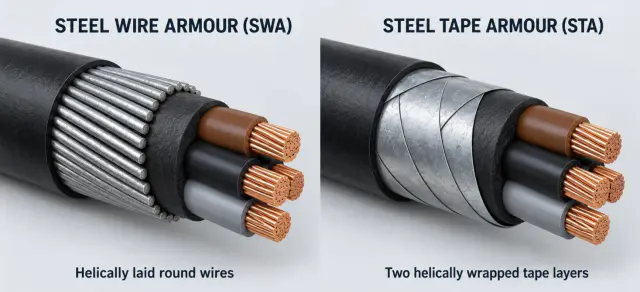
A typical SWA cable has galvanised steel wires laid helically around the bedding beneath the outer sheath. The individual wires form a mechanically protective layer around the cable cores. The conductor, insulation and sheath remain separate components with their own functions.
What Is Steel Tape Armoured Cable?
Conventional STA uses flat steel tapes wrapped around the cable bedding. A common design has two tape layers arranged so that the outer layer covers gaps in the inner layer. Double steel tape armour is also described as DSTA.
This article compares round-wire armour with conventional wrapped tape armour. Flat-wire armour, wire braid and interlocked metallic armour are different constructions and should be assessed separately.
SWA vs STA Cable Comparison Table
|
Selection factor |
Steel wire armour (SWA) |
Steel tape armour (STA) |
|
Armour geometry |
Individual helically laid round wires |
Flat steel tapes helically wrapped, commonly in two layers |
|
Longitudinal (tensile) loading |
Usually the stronger candidate for tensile duty |
Generally selected where significant axial loading is absent |
|
Crush and impact protection |
Discrete wires; depends on wire dimensions and complete construction |
Continuous tape coverage; depends on tape thickness and complete construction |
|
Typical routes |
Industrial routes; engineered vertical or inclined installations |
Fixed underground, duct or tunnel routes with limited axial loading |
|
Size, weight and price |
Compare the specified product; do not assume |
Often more economical in comparable conventional designs; confirm with like-for-like quotations |
|
Single-core AC suitability |
Both types: Conventional magnetic steel armour is generally unsuitable for either type; non-magnetic armour such as AWA is normally used instead |
|
|
Bending and pulling limits |
Both types: Use the exact manufacturer's limits for either type; no universal values apply |
|
|
Termination |
Both types: The gland must suit the armour type and the cable dimensions |
|
2. Mechanical Protection: Crush, Impact and Penetration
Both SWA and STA add a metallic barrier against mechanical damage. However, tensile strength, crush resistance and impact resistance are different properties. A cable that handles a higher pulling load does not necessarily outperform another cable under every crushing or impact condition.
Because flat tapes cover the surface continuously, they tend to spread localised contact over a wider area, whereas wire armour consists of discrete load-carrying elements. Actual performance also depends on steel grade, wire diameter or tape thickness, bedding support and the direction of the applied force.
Ask for test evidence relevant to the expected hazard. Do not infer an impact rating or resistance to excavation damage from the letters SWA or STA alone.
3. Tensile Loads: Pulling, Vertical Runs and Inclined Routes
Longitudinal loading is often the most useful distinction. Wire armour can contribute to tensile load capacity when the cable and load-transfer arrangement are designed for that purpose.
For a vertical riser or steep incline, assess cable self-weight, support spacing and the loads transferred to clamps and terminations. Selecting SWA does not, by itself, establish an allowable unsupported length.
For either construction, specify the permitted pulling method and maximum pulling tension. An installation calculation should also consider friction, bends and sidewall pressure. The armour label alone cannot provide these limits.
4. Flexibility and Minimum Bending Radius
Neither SWA nor STA has one universal bending radius. Cable diameter, conductor design, insulation, screens, armour geometry and installation temperature all affect handling.
Compare equivalent products and distinguish installation bending limits from final fixed-position limits. Standard fixed-installation armoured cable should not be assumed suitable for continuous flexing or repeated movement.
5. Cable Diameter, Weight and Total Cost
Armour geometry changes the amount and distribution of steel around a cable. Thin tape layers can produce a compact armour build, but STA is not automatically smaller or lighter than every SWA cable. Compare overall diameter and mass per metre for the same conductor size, core count, voltage rating and sheath specification.
STA is often the more economical option in otherwise comparable conventional designs. A useful purchasing comparison includes cable, transport, drum handling, installation labour, supports, glands and any additional route protection. A lower cable price can be offset by installation requirements.
6. Electrical Performance: Earthing and Single-Core AC Cables
Current-Carrying Capacity
Armour is primarily a mechanical protection component. SWA or STA alone does not determine ampacity. Use ratings or calculations for the actual conductor, insulation, installation method and thermal environment.
Earthing and Fault Protection
Armour bonding and its use as a protective conductor are separate design questions. Where armour is intended to carry fault current, verify continuity, fault-loop impedance, thermal withstand and protective-device operation under the applicable rules.
Single-Core AC Applications
Conventional ferromagnetic steel armour around an individual AC conductor can create additional magnetic losses and heating. Single-core AC power cables therefore normally use non-magnetic armour, such as aluminium wire armour (AWA), where armour is required. Switching from steel wire to steel tape does not resolve this issue.
7. Corrosion, Moisture and Fire Performance
Corrosion and Moisture
The complete cable construction determines environmental suitability. Galvanising helps protect steel, but sheath damage or poorly sealed accessories can expose the armour to moisture and corrosive conditions. Specify the appropriate sheath, seals and any water-blocking requirements for the route; the armour itself is not a watertight barrier.
Fire Performance
SWA and STA do not identify a fire-performance class. Flame spread, smoke, halogen emissions and circuit integrity depend on the specified materials and tested construction. PVC and low smoke zero halogen (LSZH) sheath options are separate from the choice of armour.
8. Cable Glands, Joints and Installation Work
An armour termination must match the cable's geometry and dimensions. A gland suitable for one SWA cable is not automatically suitable for an STA cable of the same outside diameter.
Confirm the armour clamping range, bedding diameter, outer diameter, sealing requirements and equipment entry. Follow the accessory manufacturer's instructions for armour retention and electrical continuity.
Accessory compatibility should be checked before ordering the cable, particularly when replacing an existing cable with a different armour type.
9. Applications: Which Armour Fits the Route?
The following examples apply the distinctions above to preliminary selection:
- Fixed underground distribution:Evaluate STA or SWA against the specified mechanical hazards, earthing arrangement and local installation requirements. Suitability for direct burial applies to the complete cable and installation, not to the armour type alone.
- Long pulls or vertical and inclined routes:Evaluate SWA where longitudinal loading matters, together with pulling calculations and engineered supports.
- Industrial trays and ducts:Compare both constructions against impact exposure, route geometry, available space and accessory compatibility.
- Single-core AC feeders:Begin with an approved non-magnetic armour design, commonly AWA.
- Submarine, suspended or moving applications:Require a cable specifically designed for that duty. Ordinary SWA is not automatically a submarine cable, aerial support member or dynamic cable.
10. Standards and What to Include in a Request for Quotation (RFQ)
Specify the governing product standard and edition, together with the local installation rules. IEC 60502-1 covers extruded-insulation power cables rated at 1 kV and 3 kV; IEC 60502-2 covers those rated from 6 kV to 30 kV. An armour abbreviation does not prove compliance with either standard.
For a meaningful SWA-versus-STA quotation, provide:
- Voltage rating, AC or DC service, conductor material, size and core count.
- Installation route, burial conditions, bends and vertical sections.
- Required mechanical duty, pulling limits and support arrangement.
- Insulation, sheath, environmental and fire-performance requirements.
- Earthing design, compatible accessories and required test documentation.
Request the construction drawing, dimensional data and installation limits for each proposed cable. Select the armour that meets the documented duty at an appropriate total installed cost.
Summary: Choosing Between SWA and STA
SWA is generally the stronger candidate where longitudinal tensile loading matters, such as long pulls and vertical or inclined runs. STA is commonly chosen for fixed routes with limited axial loading and is often more economical in otherwise comparable conventional designs.
Neither armour type resolves magnetic losses in single-core AC cables, identifies a fire-performance class or replaces manufacturer data. Base the final choice on the documented duty, the complete cable construction, accessory compatibility and total installed cost.
Frequently Asked Questions
What Is the Main Difference Between SWA and STA Cable?
SWA uses individual steel wires, while conventional STA uses wrapped steel tapes. Wire armour is generally the stronger candidate when longitudinal tensile loading is a key requirement.
Is Steel Tape Armoured Cable Suitable for Underground Installation?
It can be, provided the complete cable is approved for the burial conditions, the expected mechanical hazards and the applicable installation rules.
Is SWA Always Stronger Than STA?
No. Tensile capacity, crush resistance and impact resistance require different assessments, so “stronger” depends on the property being compared. SWA is generally the stronger candidate for tensile duty, but that does not make it superior in every application.
Is STA Cheaper Than SWA?
Often, in otherwise comparable conventional designs, but not always. Compare like-for-like quotations and include transport, drum handling, installation labour, supports and glands in the total installed cost.
Can Steel Armour Be Used as the Earth Conductor?
Only where the applicable rules permit it and the design verifies adequate continuity, impedance and fault-current withstand. Its presence alone is insufficient.
Are Armoured and Armored Cable Different Products?
No. These are British and American spellings. Compare the cable specification, rather than the spelling used in a catalogue.

- +86-13588204183
- No. 39 Zhiyuan Road, Deqing Economic Development Zone, Huzhou City, Zhejiang Province

Copyright © Zhejiang Huapu Cable Co., Ltd. All Rights Reserved.
 ISO 9001 Cable Manufacturer