
 en
en English
 中文简体
中文简体 русский
 Español
 عربى
عربى
Structured Cabling vs Point-to-Point: A Complete Guide for 2026
Content
- Quick Answer: Structured Cabling vs Point-to-Point
- What Is Structured Cabling?
- What Is Point-to-Point Cabling?
- Structured Cabling vs Point-to-Point: Side-by-Side Comparison
- Pros and Cons of Structured Cabling
- Pros and Cons of Point-to-Point Cabling
- When Should You Choose Structured Cabling?
- When Might Point-to-Point Cabling Be Acceptable?
- Cost Comparison: Short-Term vs Long-Term
- Future-Proofing Your Network
- How to Choose the Right Cabling Partner
- Frequently Asked Questions
- Conclusion
When designing or upgrading a network infrastructure, one of the most important decisions you'll face is choosing between structured cabling and point-to-point cabling (sometimes called "structural cabling" by industry newcomers). The choice you make today will shape your network's performance, scalability, and maintenance costs for the next 10–20 years.
In this guide, we'll break down exactly what each cabling approach is, how they differ, and which one is the right fit for your office, data center, or enterprise environment.

Quick Answer: Structured Cabling vs Point-to-Point
Structured cabling is a standardized, organized network infrastructure built around a central patching system that follows industry standards like ANSI/TIA-568. It uses a hierarchical design with patch panels, trunk cables, and clearly defined subsystems.
Point-to-point cabling is a direct, device-to-device wiring approach where each cable runs straight from one piece of equipment to another — no patch panels, no centralized organization. It's faster to install initially but quickly becomes a tangled mess as the network grows.
For most modern businesses, structured cabling is the recommended choice because it delivers better reliability, easier troubleshooting, and far lower long-term costs.
What Is Structured Cabling?
Structured cabling is a comprehensive cabling system that supports voice, data, video, and multimedia services across an entire building or campus. Rather than running individual cables from each device to a switch, structured cabling uses a logical, layered architecture defined by international standards (ANSI/TIA-568, ISO/IEC 11801).
The 6 Subsystems of a Structured Cabling System
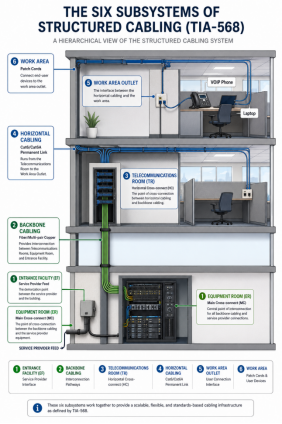
A complete structured cabling system is broken down into six standardized subsystems:
- Entrance Facility (EF)– Where the external service provider's cabling enters the building.
- Equipment Room (ER)– Houses the main servers, switches, and telecommunications equipment.
- Backbone Cabling– The vertical or inter-building cabling connecting equipment rooms to telecommunications rooms.
- Telecommunications Room (TR)– The intermediate hub where backbone cabling terminates and horizontal cabling begins.
- Horizontal Cabling– Runs from the telecommunications room to individual work area outlets, typically using Cat6, Cat6A, or fiber.
- Work Area– The end-user space, including outlets, patch cords, and connected devices.
Key Components of Structured Cabling
- Patch panelsfor organized termination and easy moves/adds/changes
- Trunk cables(high-density backbone connections)
- Cable management(cable trays, raceways, vertical/horizontal managers)
- Labeling and documentationfor every cable run
- Standardized connectors(RJ45, LC, MTP/MPO)
What Is Point-to-Point Cabling?
Point-to-point cabling — also called "direct connect" or "fly-by" wiring — is exactly what it sounds like: a single cable runs directly from one device (such as a server) to another (such as a switch port), with no intermediate patch panel or structured pathway.
In a point-to-point setup, if you have 48 servers connecting to a switch, you have 48 individual cables snaking through the rack, each one terminated directly at both ends.

How Point-to-Point Cabling Works
- Each cable is dedicated to a single connection
- No patch panels, no consolidation points
- Cables are typically long, custom-cut, and run directly between endpoints
- The topology grows linearly with every new device added
While this approach can seem simpler and cheaper at first, it almost always becomes problematic as the network expands.
Structured Cabling vs Point-to-Point: Side-by-Side Comparison
|
Feature |
Structured Cabling |
Point-to-Point |
|
Installation Time (Initial) |
Longer — requires planning and patch panels |
Faster — just run a cable end-to-end |
|
Upfront Cost |
Higher |
Lower |
|
Long-Term Cost |
Lower (easy moves/adds/changes) |
Higher (re-pulling cables, troubleshooting) |
|
Scalability |
Excellent — designed for growth |
Poor — adds complexity exponentially |
|
Troubleshooting |
Easy — labeled, organized, documented |
Difficult — tracing tangled cables |
|
Airflow & Cooling |
Optimized — neat cable bundles |
Restricted — dense cable mats block airflow |
|
Aesthetics |
Clean, professional |
Chaotic |
|
Standards Compliance |
ANSI/TIA-568, ISO/IEC 11801 |
None |
|
MACs (Moves, Adds, Changes) |
Simple — re-patch at the panel |
Complex — pull and re-run cable |
|
Best For |
Offices, data centers, campuses, enterprises |
Small temporary setups, isolated equipment |
Pros and Cons of Structured Cabling
Advantages
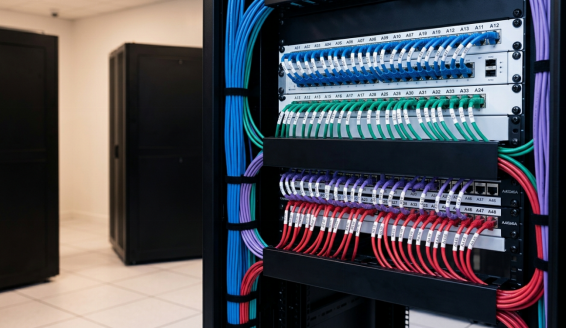
- Scalable architecture: Easily add new connections by patching at the panel
- Standards-based: Compliant with TIA, ISO, and BICSI guidelines
- Future-proof: Supports upgrades to higher-bandwidth applications (10G, 40G, 100G, 400G)
- Faster troubleshooting: Clearly labeled, documented connections
- Better airflow: Organized bundles improve cooling efficiency in racks and data halls
- Lower TCO: Reduced long-term operational and maintenance costs
- Aesthetic and professional: Critical for client-facing facilities and audits
Disadvantages
- Higher upfront investmentfor patch panels, cable management, and skilled installation
- Requires planning and designbefore deployment
- Longer initial installation time
Pros and Cons of Point-to-Point Cabling
Advantages
- Lower upfront cost— no patch panels or cable managers required
- Faster initial deploymentfor small, simple setups
- Slightly lower latency in theory(no intermediate connection points), though negligible in practice
- Acceptable for temporary or isolated installations
Disadvantages
- Exponentially harder to manageas the network grows
- Airflow problemsin dense racks, which can cause overheating
- Difficult troubleshooting— finding a single bad cable in a bundle is time-consuming
- Disruptive moves and changes— replacing one device often requires re-running multiple cables
- No standards compliance, which can affect warranties, certifications, and audits
- Higher long-term costdue to maintenance, downtime, and cable replacement
When Should You Choose Structured Cabling?
Structured cabling is the right choice if any of the following apply:
- You're building or renovating an office, data center, or campus
- You expect to scalethe network in the next 5–10 years
- You need to support multiple services(voice, data, video, security, IoT)
- Your business requires high uptime and fast troubleshooting
- You need to comply with industry standardsor pass an audit
- You're deploying high-speed networks(10GBASE-T, 25/40/100/400G fiber)
In short: if your network needs to support a real business, structured cabling is the standard.
When Might Point-to-Point Cabling Be Acceptable?
Point-to-point cabling can make sense in a very limited set of scenarios:
- Small home labswith fewer than 10 devices
- Temporary installations(event networks, pop-up sites)
- Highly isolated point connections(a single uplink between two switches in adjacent racks)
- Ultra-low-latency trading environmentswhere every nanosecond matters and connections are dedicated
For anything beyond these niche cases, point-to-point quickly becomes a liability.
Cost Comparison: Short-Term vs Long-Term
Many businesses choose point-to-point cabling because the upfront cost looks lower. But when you factor in the total cost of ownership (TCO) over a 10-year window, structured cabling typically wins by a wide margin.
|
Cost Factor |
Structured Cabling |
Point-to-Point |
|
Initial install |
$$$ |
$$ |
|
Labor for adds/moves |
$ |
$$$ |
|
Downtime during changes |
Minimal |
High |
|
Troubleshooting hours |
Low |
High |
|
Re-cabling on equipment refresh |
Rare |
Frequent |
|
10-Year TCO |
Lower |
Higher |
The savings on day one rarely outweigh the operational pain over years of ownership.
Future-Proofing Your Network
Bandwidth demands roughly double every few years. Modern structured cabling systems are designed to support this trajectory:
- Cat6A coppersupports 10GBASE-T up to 100 meters
- OM4/OM5 multimode fibersupports 100G and beyond
- OS2 single-mode fibersupports 400G and is the long-term backbone choice for data centers
- MTP/MPO connectorsenable high-density 40G/100G/400G migrations
By contrast, a point-to-point network often requires a complete re-pull to accommodate higher-speed media — a far more disruptive and expensive process than swapping patch cords on a structured system.
How to Choose the Right Cabling Partner
Whether you're rolling out a structured cabling project or rationalizing a legacy point-to-point environment, partner with a vendor who offers:
- Compliance with ANSI/TIA-568, ISO/IEC 11801, and BICSIbest practices
- A complete portfolio of Cat6, Cat6A, Cat7, and fiber solutions
- Pre-terminated trunk cables and MTP/MPO assembliesfor fast deployment
- Cable management accessories(patch panels, managers, labels)
- Testing and certificationto guarantee performance
Frequently Asked Questions
Is structural cabling the same as structured cabling?
Yes — "structural cabling" is a common misspelling or translation of structured cabling. The correct industry term is "structured cabling," which refers to a standardized, organized network cabling system.
Can I mix structured and point-to-point in the same network?
Technically yes, and it's common in transition periods. However, mixing approaches usually causes confusion, makes documentation harder, and should only be a temporary state during migration to a fully structured design.
How long does a structured cabling system last?
A well-designed structured cabling system typically lasts 15–25 years, often outliving 3–5 generations of network electronics. This longevity is a major reason structured cabling delivers strong ROI.
What's the difference between structured cabling and a LAN?
A LAN (Local Area Network) is the network itself — the switches, routers, and the data they carry. Structured cabling is the physical infrastructure that the LAN runs on. Think of cabling as the roads, and the LAN as the traffic.
Is point-to-point cabling cheaper than structured cabling?
Only on day one. Over the lifecycle of the network, point-to-point typically costs more due to maintenance, troubleshooting, downtime, and re-cabling expenses.
Conclusion
The debate between structured cabling vs point-to-point isn't really a debate for most businesses — structured cabling wins on nearly every dimension that matters: scalability, reliability, maintainability, and total cost of ownership.
Point-to-point cabling has a place in small, temporary, or highly specialized environments, but for any serious commercial deployment, structured cabling is the proven, standards-based foundation that will keep your network running smoothly for decades.
Ready to upgrade your network infrastructure? Contact our team for a site assessment and a quote on a structured cabling system tailored to your business.


- +86-13588204183
- No. 39 Zhiyuan Road, Deqing Economic Development Zone, Huzhou City, Zhejiang Province

Copyright © Zhejiang Huapu Cable Co., Ltd. All Rights Reserved.
 ISO 9001 Cable Manufacturer